

Last Updated on 19 August 2026 by Vanessa
Few countries are as closely associated with stray cats as Greece. For many travelers, they’re part of the experience, appearing everywhere from quiet monasteries and fishing harbors to archaeological sites and bustling town squares.
Yet there’s surprisingly little reliable information about them. Why is Greece home to so many cats? How are they cared for? What problems do they face? Which common beliefs are actually myths? And how can you help responsibly?
You’ll find all of that here in one place. This guide brings together the facts, practical advice and local context to help you better understand one of Greece’s most recognizable residents.
Stray cats in Greece: everything you need to know
Why are there so many stray cats in Greece?
It’s one of the questions visitors ask most often, and the answer isn’t as simple as “people abandon their pets.”
Greece’s large stray cat population results from centuries of history combined with modern challenges. Climate, culture, geography, and limited resources all play a role. Understanding these factors helps explain why cats have become such a familiar sight in almost every town, village, and island.

Cats have been part of Greek life for centuries
Cats haven’t always enjoyed the celebrity status they have today, but they’ve lived alongside people in Greece for hundreds of years.
Originally, people valued cats for practical reasons. They protected grain stores from rodents, kept ships free of rats, guarded monasteries, and helped fishing communities control pests around harbors and warehouses. Their hunting skills made them welcome residents long before people kept cats primarily as pets.
Many of these “working cats” reproduced quickly, and colonies gradually formed around places where food and shelter remained available.
In many places, locals have looked after these community cats for generations by providing food and water.
The climate allows cats to breed for much of the year
Unlike northern Europe, Greece has relatively mild winters.
Cats don’t need to survive months of freezing temperatures, which means more kittens survive into adulthood. Females can also go into heat for much of the year, especially in warmer southern regions and on the islands.
Without widespread sterilization, even a small colony can grow surprisingly quickly over just a few breeding seasons.
Limited neutering means the population keeps growing
The single biggest reason Greece has so many stray cats is simple: too many cats remain unsterilized.
A single female can have two to three litters a year, occasionally even four, with an average of three to five kittens per litter. That means that just one unspayed female and her offspring can produce hundreds of kittens over several years.
Although Trap-Neuter-Return (TNR) programs have expanded significantly in recent years, they still can’t keep up everywhere. Many municipalities face budget constraints, while volunteers often depend almost entirely on donations.
Pet abandonment still happens
Another contributor is pet abandonment.
Some owners abandon unwanted kittens, while others leave behind adult cats after moving house or when caring for them becomes difficult. Unfortunately, this tends to increase around the tourist season, when people sometimes assume stray cats can simply fend for themselves.
Even cats that previously lived indoors can end up joining existing colonies if they survive long enough.
Rural areas and suburbs face different challenges
Outside major cities, access to affordable veterinary care can be limited or even non-existent. This affects not only remote villages and rural areas but also some suburban communities around larger cities, where many families may struggle to afford regular veterinary care, vaccinations, and sterilization.
Farm cats often remain unsterilized because they are viewed primarily as mousers rather than companion animals. While many farmers care well for their cats, financial limitations can make routine veterinary treatment unrealistic, especially when several cats are involved.
Different attitudes toward cats
Many older generations in Greece grew up viewing stray cats as a nuisance rather than animals that deserve care and protection. These views can make people less likely to feed, sterilize, or seek medical help for cats, even when they have the financial means to do so.

How many stray cats are there in Greece?
Nobody knows the exact number.
Unlike owned pets, stray cats aren’t registered, and no nationwide census exists. Many cats move between colonies, new kittens are born throughout the year, and mortality rates vary considerably from one location to another.
Because of this, estimates differ depending on who conducts the research and how they define a stray cat.
Most animal welfare organizations and researchers estimate that Greece is home to millions of stray and community cats, with figures often ranging between 2 and 4 million.
It’s also worth remembering that these estimates often include different groups of cats. Some figures count only genuinely homeless cats, while others also include community cats that receive food and care from local residents. This makes direct comparisons difficult.
What is clear is that the cat population remains far larger than rescue organizations and municipalities can manage on their own.
Which parts of Greece have the most cats?
Some destinations have become famous for their large cat populations, while others have relatively few street cats.
If you’re curious about which islands have the highest numbers—and why—you can read my complete guide: Which Greek Island Has the Most Cats?
Changes throughout the year
The number of cats you see during your vacation depends partly on when you visit.
Spring means kitten season
As temperatures rise, breeding season begins. Volunteers suddenly find themselves caring for dozens of orphaned kittens, pregnant mothers and newborn litters.
This creates enormous pressure on rescue organizations, many of which already operate at full capacity.
Summer brings both help and challenges
Tourism has a mixed impact on Greece’s stray cats.
Many visitors buy food, leave fresh water, or donate to local rescue groups. Some even volunteer during their holidays or adopt cats they meet while traveling.
At the same time, the intense summer heat increases the risk of dehydration and heat stress, especially for kittens, elderly cats, and injured animals. Busy roads also lead to more traffic accidents, while temporary feeding by tourists can create inconsistent food sources that disappear once the holiday season ends.
Autumn can be difficult
As tourist numbers drop, so does the extra food many colonies receive from tourists.
Rescue organizations also see donations decline after the busy summer months, even though cats still need daily care.
Winter is dangerous
Greece rarely experiences the harsh winters found in northern Europe, but that doesn’t mean life becomes easy for street cats.
Cold rain, strong winds, storms and occasional snowfall can make survival difficult, particularly in mountainous regions and northern Greece. Food also becomes scarcer, and young kittens born late in the season often struggle to survive.
Throughout the year, one thing remains constant: every successful neutering campaign helps reduce future suffering. While feeding keeps cats alive today, sterilization offers one of the most effective long-term solutions to managing Greece’s stray cat population humanely.

Where do the stray cats in Greece live?
One of the things that surprises first-time visitors to Greece is just how widespread stray cats are. You don’t have to go looking for them. Chances are you’ll spot one within minutes of arriving, whether you’re wandering through a mountain village, enjoying lunch by the sea, or exploring an ancient archaeological site.
That doesn’t mean cats simply roam at random. Like all animals, they settle where they have the best chance of surviving. Food, water, shelter, and relative safety determine where colonies form and whether they thrive.
Let’s take a closer look at the places where you’re most likely to meet Greece’s street cats (and why these locations suit them so well).
Villages
Small villages often have well-established cat colonies that have existed for decades.
Unlike in busy cities, people in villages tend to know “their” cats. Several neighbors may feed the same colony, leave out water bowls or keep an eye on new kittens. It’s not uncommon for residents to recognize individual cats by name or appearance, even if nobody officially owns them.
Village cats also benefit from quieter streets, less traffic and plenty of hiding places between houses, gardens and olive groves.
That said, life isn’t necessarily easy for cats there. Veterinary care can be limited in rural areas, and volunteers may have to travel long distances to organize neutering campaigns or treat sick cats.
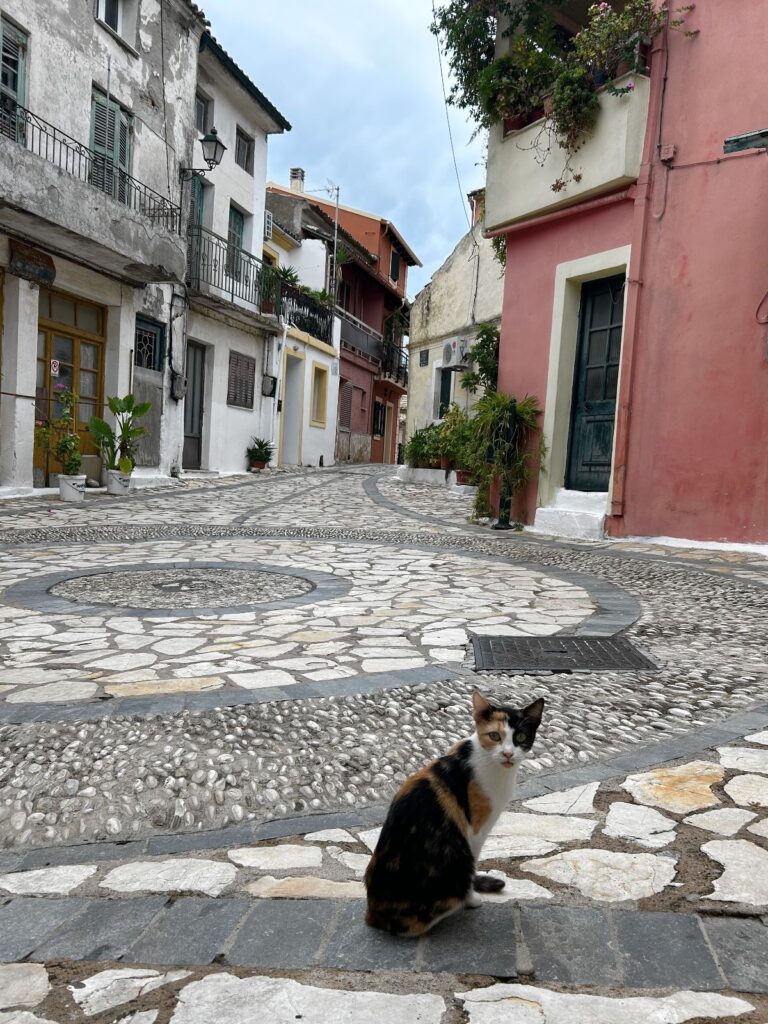
Want to know more? Below are some of the most picturesque villages in Greece, and they are all home to a large number of community cats:
Fishing harbors and marinas
Harbors have attracted cats for centuries.
Fishing boats, seafood markets and restaurants create opportunities for cats to find food, while warehouses and old stone buildings provide shelter from the elements.
Many fishermen have traditionally welcomed cats because they helped keep rats and mice away from nets, equipment and stored catches.
Today, you’ll often find entire colonies living around ports. Some are carefully looked after by local volunteers, while others depend on a mixture of fishermen, restaurant owners, and tourists.
However, despite the steady flow of people, harbors can also be dangerous. Cats face heavy traffic, fishing hooks, discarded fishing line, boats and occasional encounters with larger animals.
Here are some of our favorite Greek fishing harbors:
Restaurants and tavernas
Many visitors first fall in love with Greece’s street cats while eating outdoors.
Cats quickly learn which restaurants welcome them and which don’t. Some tavernas leave out fresh water and cat food every day, while others discourage cats from entering dining areas.
It’s worth remembering though that a cat sitting patiently beside your table doesn’t necessarily mean it’s starving. Many community cats receive several meals a day from different people and simply know that tourists are often willing to share.
If you decide to feed a cat, choose appropriate cat food whenever possible instead of scraps from your own meal. Foods that are perfectly safe for people can upset a cat’s digestive system or lack the nutrients it needs.

Hotels and holiday resorts
Many hotels care for resident cats.
Staff members often feed them, arrange neutering through local rescue groups and even give them names. Guests return year after year hoping to see the same familiar feline waiting in the garden or lounging by the pool.
Some hotels actively support local animal welfare organizations, while others simply tolerate the cats’ presence.
Unfortunately, not every resort welcomes them. In some places, cats may be chased away or prevented from accessing food and water.
If you notice healthy-looking cats around your accommodation, it’s worth asking the staff whether they’re part of a managed colony before assuming they need rescuing.
Archaeological sites
It’s almost impossible to visit some of Greece’s historic sites without spotting at least one cat.
Ruins offer excellent shelter, plenty of sunny resting spots and relatively few natural predators. Staff and visitors often leave out food, and nearby cafés provide additional opportunities.
Cats have become such familiar residents at some archaeological sites that many visitors consider them part of the experience.
While they certainly add charm, it’s important to remember that these cats still depend on responsible care and population management.
Ready to discover Greece’s most unforgettable cat-filled historic sites? These archaeological treasures are a great place to start:

Beaches
Beach cats tend to appear wherever people gather.
During summer, they may receive food from tourists or nearby cafés. Some spend the day resting beneath sunbeds or shrubs before becoming more active in the cooler evening hours.
Winter tells a different story.
Once the tourists leave, many beach colonies lose an important source of food, making survival much harder until the next holiday season begins.
Some of our favorite beaches with cats are in:
Campsites
Campsites often become temporary feeding grounds for local cats.
Campers may leave leftovers or intentionally feed them, while bins provide additional food sources.
Although this can help cats survive during the busy season, it also creates challenges. Human food isn’t always suitable, and inconsistent feeding means colonies may struggle once the campsite closes for winter.
Farms and olive groves
Rural Greece supports countless farm cats.
Many farmers appreciate having cats around because they naturally control rodents that would otherwise damage crops or animal feed.
Some farm cats live almost entirely independently, while others receive regular meals and basic care.
Because these cats often reproduce freely, farms can become important locations for Trap-Neuter-Return programs.
Monasteries and churches
Cats have lived around Greek monasteries for centuries.
Historically, they protected food stores from rodents and became valued members of monastery life.
Many monasteries continue to feed resident cats today, and visitors often notice them quietly resting in courtyards or wandering through peaceful gardens.
Curious where you can find Greece’s most atmospheric monastery cats? These peaceful historic sites are sure to capture your heart:
- 5 famous monasteries in Crete where cats outnumber monks
- Monastery of Ypsilou (Lesbos)
- Panagia Tourliani Monastery in Ano Mera (Mykonos)
- Mystras convents in the south of Greece
- Arkadi Monastery (Crete)

Cities
Large cities like Athens and Thessaloniki support thousands of street cats.
Urban cats adapt remarkably well. They shelter beneath parked cars, inside abandoned buildings, in parks, and between apartment blocks.
City life offers more food opportunities but also more dangers. Heavy traffic, construction work, pollution and densely populated neighbourhoods all increase the risks they face.
Fortunately, cities also tend to have more rescue organizations, veterinary clinics and volunteer networks working to care for community cats.
Greek islands
Greek islands often have particularly visible cat populations. The reasons vary from island to island but often include:
- Mild weather for most of the year
- Large numbers of seasonal visitors
- Fishing communities
- Limited veterinary resources on smaller islands
- Long-established cat colonies
Some islands have become famous among cat lovers, but popularity doesn’t necessarily mean cats have easier lives. Many island rescue organizations work non-stop with limited funding, and they rely heavily on volunteers and donations.
Check out the cat populations on the islands of:
What problems do stray cats in Greece face?
It’s easy to envy a cat sleeping peacefully on a sunny stone wall.
From the outside, life can seem wonderfully carefree. The cat stretches, dozes in the sunshine, and accepts the occasional treat from passing tourists.
But those quiet moments tell only part of the story.
The reality is much more complicated.
That relaxed cat basking in the afternoon sun has probably already spent hours searching for food, avoiding danger and navigating a world that’s far less comfortable than it appears.
For most street cats, every day revolves around one goal: surviving until tomorrow.
That’s why understanding their daily lives matters. Once you see what it takes for a stray cat to survive, it becomes much easier to understand why responsible, long-term solutions—not just occasional acts of kindness—make the biggest difference.
Here are the biggest problems stray cats in Greece face every day.
Hunger
Not every stray cat goes hungry. Yet very few stray cats enjoy guaranteed meals.
Cats living near restaurants, hotels or established feeding stations often receive regular meals. Others depend on whatever they can find themselves or on the generosity of passersby.
Food availability can also change dramatically throughout the year. During the busy tourist season, many cats receive extra food from visitors. Once the season ends, those additional meals disappear overnight.
Even well-meaning feeding can create problems if it isn’t done responsibly. Feeding large amounts in one place can attract more cats than the area can support, encourage fighting or leave leftovers that spoil in the heat.

Dehydration
Finding clean water can be even harder than finding food.
During the summer, temperatures regularly climb up to 35–40°C (into the 90s or even above 100°F). Small puddles evaporate quickly, fountains may stop running, and natural water sources dry up.
Without volunteers or local residents leaving out fresh water, many cats rely on dripping faucets, irrigation systems, or other unreliable sources.
Kittens, nursing mothers, and senior cats are especially vulnerable to dehydration.
Extreme heat
Summer in Greece can be brutal.
Cats cope surprisingly well with warm weather, but prolonged heat waves still take their toll. They spend the hottest part of the day hiding under parked cars, dense shrubs, abandoned buildings, or stone walls that offer a little shade.
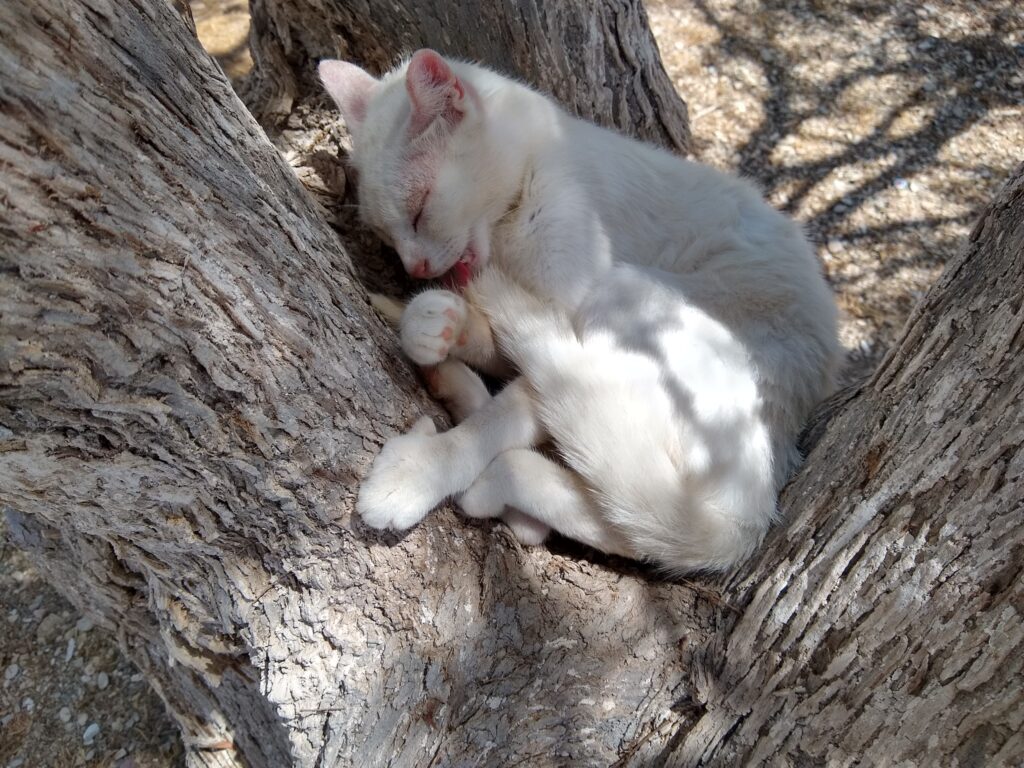
Heat stress and heatstroke become real risks when temperatures remain high for several days, especially if water is scarce. Cats, especially white ones, can also get skin cancer.
Winter weather
Many people assume Greece stays warm year-round, but winters can still be challenging.
Northern Greece experiences freezing temperatures, mountain villages receive snow, and even the islands can see cold winds and heavy rain.
Cats without adequate shelter may develop respiratory infections, hypothermia, or other health problems during prolonged periods of bad weather.

Parasites
Nearly every stray cat encounters parasites at some point.
Common parasites include:
- Fleas
- Ticks
- Ear mites
- Roundworms
- Tapeworms
- Hookworms
These parasites don’t just cause discomfort. They can lead to anemia, skin infections, digestive problems and the spread of other diseases, especially in kittens.
Disease
Without routine veterinary care, illnesses can spread quickly through cat colonies.
Many diseases can be treated if caught early, but rescue organizations often have to prioritize the most urgent cases because of limited funding.
We’ll cover the most common illnesses in detail in the next section.
Road traffic
Cars pose one of the greatest dangers to stray cats.
Many colonies live near restaurants, parking lots, and busy roads. That’s where food is available. Unfortunately, those same locations expose them to constant traffic.
Kittens are particularly at risk because they have little experience avoiding moving vehicles.
Poisoning
Sadly, poisoning still happens.
Sometimes it’s deliberate. In other cases, cats accidentally ingest pesticides, rodenticides, or toxic substances left in gardens, fields, or public spaces.
Cats can also become ill after eating spoiled food or consuming fish or meat that has gone bad in the summer heat.
Abuse and cruelty
Most people in Greece care deeply about animals, and countless individuals devote their time and money to helping stray cats.
Unfortunately, acts of cruelty still occur, especially with older generations and business owners for whom cats are a nuisance.
Animal welfare organizations continue to work toward better education, stronger enforcement of animal welfare laws, and greater public awareness.
Uncontrolled breeding
Perhaps the biggest problem of all is that there are simply too many kittens. Without widespread spaying and neutering, colonies grow faster than volunteers can manage.
This leads to overcrowding, competition for food, and more cats needing medical care than rescue organizations can provide.
Injuries from fights
Cats are territorial by nature.
When food is limited or breeding season begins, fights become more common. Bite wounds and scratches may seem minor at first but often develop into painful abscesses that require veterinary treatment.
These injuries can also spread infectious diseases between cats.

Dog attacks
Most dogs ignore cats, but not all.
Free-roaming dogs, poorly controlled pets or livestock guardian dogs can seriously injure or kill cats, especially kittens.
Cats usually avoid these encounters if they can, but escape isn’t always possible.
Fishing gear and plastic waste
Cats living near the coast face additional dangers.
Fishing hooks, discarded line, and plastic waste can cause severe injuries. Cats may swallow fishing lines, become tangled in nets, or cut their paws on sharp objects.
These injuries often require surgery, something many rescue groups cannot afford.
Wildfires and natural disasters
Large wildfires have become more common in Greece in recent years.
Cats can lose their territories, food sources, and shelter within hours. Rescue organizations often rush into affected areas to search for injured animals, but many cats disappear before help arrives.
Flooding, storms and earthquakes also create challenges, although they occur less frequently.
Limited veterinary care
One of the biggest obstacles isn’t a disease or injury. It’s access to treatment.
Many islands have only one veterinarian; some smaller islands have none. For example, on Hydra Island, if a cat needs a medical intervention, a veterinarian has to be brought in from the mainland.
Volunteers often travel long distances to arrange surgeries, vaccinations, or emergency treatment. Every appointment costs money, and demand almost always exceeds available resources. Many volunteers pay with their own money.
Pregnancy and kitten mortality
Life is hardest for the youngest cats.
Many kittens never survive their first year because of disease, parasites, malnutrition, traffic accidents, or predators.
This heartbreaking reality explains why rescue organizations place so much emphasis on spaying and neutering. Preventing unwanted litters saves far more lives than rescuing kittens after they’re born.
Diseases and health problems
Stray cats encounter a wide range of health problems throughout their lives. Some are minor and easy to treat. Others can become life-threatening if left untreated.
One important thing to remember is that many of these illnesses are preventable. Regular vaccinations, parasite control, sterilization, and prompt veterinary care dramatically improve a cat’s chances of living a long and healthy life.
Below are the conditions rescue organizations and veterinarians see most often among stray cats in Greece.
Feline parvovirus
Feline parvovirus (feline panleukopenia virus) is a very serious and highly contagious illness that commonly affects stray cats and kittens in Greece, especially those that have not been vaccinated. The virus spreads easily through contact with an infected cat, its faeces, or contaminated areas such as feeding spots, bedding, and shelters. It can survive in the environment for a long time, which makes it a particular challenge for stray cat colonies. Infected cats may show signs such as tiredness, loss of appetite, vomiting, diarrhoea, fever, dehydration, and weakness.
The best way to protect stray cats from parvovirus is through prevention. Vaccinating kittens and adult cats whenever possible, keeping feeding areas clean, separating sick cats from healthy ones, and disinfecting shared items can greatly reduce the risk of spreading the disease.
There is no medicine that directly kills the virus, but cats can recover with fast veterinary care, including fluids, nutritional support, medication for symptoms, and treatment for infections that may occur. For stray cats in Greece, early help and support can make the difference between life and death, especially for young kittens who are most vulnerable.

Fleas
Fleas are one of the most common parasites affecting stray cats.
A few fleas may seem harmless, but heavy infestations can cause severe itching, hair loss, skin infections, and anemia. Fleas also transmit tapeworms and other diseases.
Modern flea preventatives provide excellent protection, but treating entire colonies requires ongoing funding and volunteer effort.
Ticks
Ticks are particularly common in rural areas, forests and farmland.
Besides causing irritation, ticks can transmit diseases that affect both cats and other animals.
Removing ticks safely with rget=”_blank” rel=”noopener”>a trick remover and using preventative treatments helps reduce the risk.
Ear mites
Ear mites live inside the ear canal and feed on skin debris.
Cats with ear mites often shake their heads, scratch constantly or develop a dark, crumbly discharge inside their ears.
Fortunately, treatment is usually straightforward once the problem is diagnosed.
Intestinal worms
Many kittens and adult stray cats carry intestinal parasites.
The most common include:
- Roundworms
- Tapeworms
- Hookworms
Symptoms may include diarrhea, weight loss, vomiting, poor growth and a dull coat.
Routine deworming greatly reduces these problems.
Ringworm
Despite its name, ringworm isn’t caused by a worm. It’s a fungal infection.
It usually causes circular patches of hair loss, flaky skin and broken hairs.
Because ringworm can spread to people and other animals, rescue groups treat affected cats carefully and practice good hygiene.

Mange
Mange results from microscopic mites living in the skin.
Affected cats often develop intense itching, crusty skin and significant hair loss.
Prompt treatment usually leads to a full recovery.
Cat flu
Cat flu refers to common viral respiratory infections.
Typical symptoms include:
- Sneezing
- Runny nose
- Watery eyes
- Fever
- Loss of appetite
Young kittens and cats with weakened immune systems face the greatest risk of complications.
Vaccination significantly reduces severe illness.
Eye infections
Eye infections are common among stray cats, particularly kittens.
Without treatment, simple infections can progress to corneal ulcers, permanent vision loss or blindness.
If you see a cat with swollen, closed or heavily discharging eyes, it needs veterinary attention as soon as possible.
Dental disease
Broken teeth, gum disease and severe tartar buildup often go untreated in stray cats.
Painful mouths make eating difficult, which can lead to weight loss and poor overall health.
Abscesses
Bite wounds frequently develop into abscesses.
These painful pockets of infection often swell dramatically before bursting.
Veterinary treatment usually involves draining the abscess, cleaning the wound and prescribing antibiotics.
Broken bones
Traffic accidents, falls and dog attacks can all cause fractures.
Some cats recover remarkably well on their own, but many require surgery or prolonged veterinary care.

Feline Leukemia Virus (FeLV)
FeLV weakens a cat’s immune system and increases the risk of cancer and secondary infections.
The virus spreads mainly through prolonged close contact, such as grooming or sharing food bowls.
Vaccination can help protect cats that test negative.
Feline Immunodeficiency Virus (FIV)
FIV affects the immune system but isn’t the same as HIV in humans.
It spreads primarily through deep bite wounds, making unneutered male cats particularly vulnerable.
Many FIV-positive cats still live long, happy lives with appropriate care.
Feline Infectious Peritonitis (FIP)
FIP develops from a mutation of a common feline coronavirus.
For many years it was considered almost always fatal, but newer treatments have dramatically improved survival rates when cats receive treatment early.
Rabies
People often worry about rabies when they meet stray animals abroad.
The good news is that rabies is extremely rare in cats in Greece. The country maintains strict surveillance and control measures, and the risk to tourists from stray cats is considered very low.
Even so, you should always seek medical advice if you’re bitten or scratched deeply by any unfamiliar animal.
Poisoning
Poisoning can result from pesticides, rodenticides, toxic plants, or contaminated food. Unfortunately, because many businesses in Greece see cats as rodents, they often poison cats as well. Regulations have been put into place and help a little but are not always strictly followed.
Symptoms vary widely but may include vomiting, seizures, weakness or difficulty breathing.
Poisoning always requires emergency veterinary treatment.

Heatstroke
Cats tolerate heat better than many people realize, but they aren’t immune to extreme temperatures.
Signs of heatstroke include heavy panting, weakness, drooling, and collapse.
Providing fresh water and plenty of shade helps reduce the risk.
Skin cancer
Greece’s strong sunshine puts light-colored cats, especially white cats, at greater risk of developing skin cancer. The ears, nose, eyelids, and other areas with little fur receive the most UV exposure and often develop damage first.
Applying a pet-safe sunscreen to these exposed areas can help reduce the risk, particularly in cats that spend long hours in direct sunlight. Regularly checking for sores, scabs or wounds that don’t heal also allows treatment to start as early as possible.
Malnutrition
Not every thin cat is starving. Older cats, sick cats, and cats with heavy parasite burdens may lose weight even when food is available.
True malnutrition weakens the immune system, slows healing, and makes cats more susceptible to disease. Consider purchasing some high calorie nutritional gel to give to those cats that need it most.
Injuries from fights
Cuts and puncture wounds may seem small from the outside, but bacteria trapped beneath the skin often lead to painful infections.
Neutering reduces aggressive behavior and lowers the number of serious fights.
Tail injuries
Tail injuries commonly result from traffic accidents, doors, traps, or fights.
Depending on the severity, cats may recover fully or require partial tail amputation.</p>
Missing limbs
Some stray cats adapt incredibly well after losing a leg because of trauma or severe injury.
Three-legged cats can still enjoy an excellent quality of life, provided they receive proper veterinary care and enough food.
Blindness
Blindness may result from untreated eye infections, injuries, glaucoma, or other medical conditions.
Many blind cats continue to navigate familiar territories successfully, especially when volunteers care for established colonies.
Common kitten illnesses
Kittens face the highest risk of illness and death.
The most common health problems include:
- Upper respiratory infections
- Eye infections
- Intestinal parasites
- Flea infestations
- Diarrhea
- Dehydration
- Malnutrition
Because kittens have immature immune systems, even conditions that seem minor can become life-threatening within a short time.
The encouraging news is that many of these diseases are preventable or highly treatable. Every cat that receives vaccinations, parasite treatment, sterilization, and timely veterinary care has a much better chance of living a healthy life. That’s why supporting local rescue organizations and Trap-Neuter-Return programs has such a lasting impact—not just for individual cats, but for entire colonies.
Common mistakes tourists make that can harm stray cats
Most people who interact with Greece’s stray cats have the best intentions. They see a friendly cat, want to help, and do what feels right in the moment.
Unfortunately, some well-meant actions can do more harm than good. A little knowledge goes a long way, and avoiding these common mistakes can make your help far more effective.
Giving cats cow’s milk
It’s probably the most common myth about cats.
Most adult cats are lactose intolerant, which means drinking milk can cause stomach upset, diarrhea and dehydration. A bowl of fresh water is almost always a much better gift than a bowl of milk.
Feeding human food
A few bites of grilled chicken won’t usually hurt a healthy cat, but many foods people eat aren’t suitable for cats.
Salty meats, heavily seasoned dishes, onions, garlic, chocolate, alcohol, and cooked bones can all cause health problems. Even fish that’s heavily salted or fried isn’t an ideal meal.
If you want to feed a stray cat, buying a small bag or pouch of cat food from a local supermarket is one of the safest and healthiest options.
Also, some cats may be part of a managed colony and receive daily meals adapted to their health condition. Additional feeding may intervene with their treatment.
Feeding too much at once
It can be tempting to empty an entire bag of food in front of a hungry-looking cat.
The problem is that leftovers spoil quickly in the Greek heat. Food can attract insects, rodents and other animals, and large piles of food may encourage fights between cats.
Smaller portions that cats can finish quickly are usually the better choice.
Leaving food in plastic trays or packaging
Disposable food containers often end up blowing away or becoming litter.
Cats and other wildlife may also injure themselves on sharp packaging or become trapped in plastic bags.
Whenever possible, remove any packaging after feeding, and leave the area as clean as you found it.
Feeding cats next to busy roads
Some tourists stop as soon as they see a cat, even if it’s standing beside a busy road.
Unfortunately, putting food there encourages cats to stay in a dangerous location or cross the road repeatedly as more people stop to feed them.
If it’s safe to do so, move a short distance away from traffic before offering food.
Taking healthy kittens away from their mother
Finding kittens alone doesn’t automatically mean they’ve been abandoned.
Mother cats often leave their kittens for a few hours while searching for food. If someone removes the kittens too soon, they may separate an entire family that would otherwise have been fine.
Unless a kitten is clearly injured, in immediate danger, or crying continuously for many hours without any sign of its mother, it’s usually best to observe from a distance before intervening.
Assuming every cat Is homeless
Many community cats are extremely social because they interact with people every day.
A clean, friendly cat relaxing outside a café may already receive regular food and veterinary care from local residents or volunteers.
Before trying to “rescue” a cat, ask nearby business owners or local caregivers whether they know the animal.

Wanting to take a cat home without following the rules
Every year, visitors fall in love with a Greek cat and want to give it a permanent home.
While that’s a wonderful outcome when done properly, taking a cat home isn’t as simple as buying a plane ticket.
Cats need veterinary examinations, vaccinations, a microchip, official paperwork, and enough time to meet the import requirements of the destination country.
Working with a local rescue organization helps ensure everything is done legally and safely. You can learn more about this process in our article How to adopt a cat in Greece: a step-by-step guide.
Ignoring signs of serious illness
Not every skinny cat needs emergency help, but some warning signs should never be ignored.
These include:
- Severe wounds
- Difficulty breathing
- Inability to stand
- Heavy bleeding
- Eyes that are completely closed by infection
- Obvious broken bones
- Seizures
If you notice a cat with severe injuries, contact a local rescue organization or veterinarian as soon as possible.
Touching sick cats without washing your hands
Most feline illnesses don’t spread to people, but good hygiene still matters.
Wash your hands after handling unfamiliar cats, especially before eating or touching another animal. This also helps prevent diseases from spreading between cats.
Moving cats to a different area
People sometimes assume a cat would be happier somewhere quieter.
In reality, cats are highly territorial. Moving a healthy adult cat away from its familiar environment can leave it unable to find food, water, or shelter. It may also lead to conflicts with established colonies.
Unless a rescue organization advises otherwise, it’s usually best to leave healthy community cats where they already know how to survive.
Expecting volunteers or organizations to handle everything
Many people see an injured stray cat and assume that a local volunteer, rescue group, or animal organization will step in and take care of everything.
These groups are often the reason many cats survive at all, and they will usually do whatever they can to help.
However, it is important to remember that most volunteers are not full-time rescuers. Many have regular jobs, families, and other responsibilities, while also trying to help many animals at the same time.
In many places, rescue organizations are operating with limited resources. They may not have enough available foster homes, transportation options, or funding for emergency treatment. Veterinary care can be expensive, and when donations or official support are not available, volunteers sometimes end up paying medical bills themselves.
If you find an injured cat, contacting a local rescuer is still a great idea, especially if you need advice or help. But whenever possible, the most effective thing you can do is take the cat to a veterinarian yourself.
Even offering transportation, staying with the cat during treatment, or helping with the cost of care can make a huge difference. A quick response from the person who found the animal can save valuable time and reduce the pressure on the people already working hard to help.

How you can help stray cats while you’re in Greece
Helping stray cats doesn’t require a huge budget or weeks of volunteer work.
Small, thoughtful actions often make a meaningful difference, especially when they’re done responsibly.
Leave out fresh water
During the hottest months, clean water can save lives.
If you’re staying in one place for several days, ask your accommodation whether it’s okay to leave a bowl of fresh water in a safe location that’s already used by local cats.
Replace the water regularly and keep the bowl clean.
Feed cats responsibly
If you choose to feed cats, buy nutritionally balanced cat food from a local supermarket or pet store.
Feed moderate amounts, clean up afterward, and avoid creating mess or attracting unwanted animals.
If you notice someone already feeding the colony, ask whether there’s a preferred feeding routine.
Support local businesses that care for cats
Many cafés, restaurants, and hotels quietly spend their own money feeding and caring for community cats.
Choosing these businesses helps reward responsible animal welfare while supporting the local economy.
Here are a few of our favorites (more will follow soon):
- Hotels in Lesbos that feed and care for stray cats
- Hotels in Athens that feed and care for stray cats
Contact a local rescue organization if you find an injured cat
If you discover a cat that’s seriously injured or clearly unable to care for itself, don’t assume someone else has already reported it.
Take photos, note the exact location, and contact the nearest rescue group or veterinarian.
The more accurate your information, the faster volunteers can respond.
Here are a few to help you out:
Of course, if you have some experience, consider traveling with a pet first-aid kit, and do whatever you can to help the injured cat yourself.
Drive carefully
Many cats rest beneath parked cars because they’re cool and shaded.
Before driving away, take a quick look underneath your vehicle or gently tap the hood. It only takes a few seconds and could save a cat’s life.
Drive slowly in areas where cats are common, especially near harbors, villages and campsites.

Donate
If you spot a donation box for a local rescue organization in a shop, café, hotel, or veterinary clinic, consider dropping in a euro or two. It may not seem like much, but if hundreds of passing tourists did the same, those small donations would add up quickly and help fund food, veterinary care, and sterilization programs for countless cats.
Volunteer for a day
Some rescue organizations welcome short-term volunteers.
Depending on their needs, you might help with:
- Feeding colonies
- Cleaning shelters
- Transporting cats
- Socializing kittens
- Preparing supplies
- Assisting at fundraising events
If you’re interested, contact the organization before your trip to see whether they can accommodate visitors.
Donate supplies
Rescue groups always need more than money.
Useful donations may include unopened cat food, kitten formula, blankets, towels, carriers, litter, cleaning supplies, and flea treatments.
Ask what they need most before buying anything.
Choose cat-friendly activities
Your sightseeing plans can also support Greece’s stray cats. For example, there’s a walking tour in Athens that donates all of its proceeds to feeding and caring for stray cats.
It’s also worth checking whether your destination has a cat café. Many cat cafés in Greece donate part of their revenue to local animal shelters, foster former stray cats, or help them find permanent homes. To find one near your destination, browse our complete guide to all the cat cafés in Greece.
Spread awareness
Sharing photos of cats in Greece can inspire others to help, but try to tell the full story.
Instead of posting only adorable vacation snapshots, mention the rescue organization caring for the colony or explain how people can support local sterilization efforts.
Sharing this article with friends and family or on social media also helps raise awareness, especially among people planning a trip to Greece. You can make an even bigger difference by sharing important updates, adoption appeals, and fundraising campaigns from your favorite rescue organizations.
That way, your social media posts become part of the solution rather than simply showcasing the problem.
How you can help stray cats from abroad
You don’t have to travel to Greece to make a difference.
In fact, many of the people who keep Greek rescue organizations running live in other countries. They donate their time, skills and resources year-round, helping volunteers continue their work long after the tourist season ends.
If you’d like to support Greece’s stray cats from home, here are some of the most effective ways to do it.
Donate to rescue organizations
Donations make the biggest impact. Sponsoring the cost of even a single TNR procedure helps prevent countless future litters and reduces pressure on already overwhelmed rescue organizations.
Regular monthly donations are even better because they help rescue organizations plan ahead and to budget for food, medications, sterilization campaigns, and emergency veterinary care throughout the year.
Many groups allow you to sponsor individual cats or support larger TNR campaigns. Follow your favorite rescue groups on social media to receive updates about upcoming fundraising campaigns.
By the way, did you know that Traveling Cats is regularly organizing fundraisers for animal shelters and rescue groups we love to support? This summer, we are collecting funds for Lesvos Stray Cats Dogs NGO. Feel free to share and contribute.
Sponsor food and supplies
Feeding hundreds of cats every day is one of the biggest ongoing expenses for rescue groups.
Donating food helps ensure that managed colonies continue receiving consistent meals, even during the quieter winter months when donations often decline.
Many organizations also maintain online wish lists containing the supplies they need most. These can include litter, food and water bowls, blankets, cleaning products, and basic veterinary supplies.
Instead of guessing what would be useful, you can purchase exactly what’s required and have it shipped directly to the rescue.
Adopt a Greek rescue cat
Few experiences are as memorable as meeting a cat on holiday and realizing you don’t want to say goodbye.
Many visitors form strong bonds with Greek street cats. A cat that follows you through a village, waits outside your hotel, or sleeps beside your restaurant table can quickly become more than just part of your vacation memories.
For some people, that connection becomes the beginning of an adoption journey.
Adopting a Greek rescue cat is absolutely possible and can be incredibly rewarding. We have an entire article on how to adopt a stray cat in Greece if you want to know more.
However, not every cat you love needs to be adopted.
This can be a difficult realization for many visitors.
A friendly cat living outside may already have a good life within a caring community. It may have a feeding routine, familiar territory, and people looking after it.
Sometimes the best way to help is not taking a cat home, but supporting the people who already care for it.
Become a foster parent
Not every rescue has enough foster homes.
If an organization in your own country works with Greek rescue groups, fostering newly arrived cats can make international adoptions possible.
Even short-term fostering helps prepare cats for their forever homes.
One simple click can change a cat’s future.
Rescue organizations rely heavily on social media to find adopters. Sharing adoption posts exposes cats to a much larger audience and sometimes connects them with the perfect family.
The same goes for fundraising projects, but make sure to only sponsor fundraising campaigns from rescue organizations you know and trust.
Offer your professional skills
Animal rescue requires far more than feeding cats.
Organizations often need help with:
- Website design
- Search engine optimization (SEO)
- Translations
- Graphic design
- Photography
- Video editing
- Social media management
- Accounting
- Legal advice
- Grant writing
- Marketing
- Copywriting
If you have professional experience in any of these areas, donating a few hours each month may be worth far more than a financial contribution.
Organize a fundraiser
Schools, workplaces, sports clubs, and community groups often look for meaningful causes to support.
You could organize:
- Charity bake sales
- Sponsored walks
- Online auctions
- Birthday fundraisers
- Holiday donation drives
- Pet photo contests
These events also help raise awareness among people who may never have considered the challenges facing Greece’s stray cats.
Support rescue projects through books, calendars, and more
Many shelters and rescue organizations create charity calendars, walking tours, books, and other merchandise to raise funds for vital work such as TNR (trap-neuter-return), medical care, food, and shelter support.
Encourage responsible tourism
If friends or family are planning a trip to Greece, send them this article and encourage them to learn about responsible ways to interact with stray cats before they travel.
Helping just a few more people avoid common mistakes can improve life for countless cats over time.
Every form of help matters
It’s easy to assume that only large donations make a difference.
The truth is that rescue organizations depend on thousands of individual acts of kindness. One person shares an adoption post. Another sponsors a spay. Someone else translates a website or donates a few cans of food.
On their own, these actions may seem small. But together, they help volunteers care for cats today while working toward a future where far fewer kittens are born into life on the streets.
Trap-Neuter-Return (TNR): the most effective way to help stray cats in Greece
When people first discover the scale of Greece’s stray cat population, their instinct is often to rescue as many cats as possible.
And while rescuing individual cats absolutely saves lives, it cannot solve the bigger problem on its own.
The reality is that there are simply more cats being born than rescue organizations can house, treat, and re-home. This is where Trap-Neuter-Return, commonly known as TNR, becomes one of the most important tools in improving the lives of community cats.
TNR focuses on preventing future suffering rather than only responding after cats become sick, injured or abandoned.
What is Trap-Neuter-Return?
Trap-Neuter-Return is a humane population management method used around the world for free-roaming cats.
The process has three main steps:
- Trap: Volunteers safely capture a cat using a humane trap.
- Neuter: A veterinarian sterilizes the cat, checks its health, treats urgent medical issues and often provides vaccinations or parasite prevention.
- Return: Once the cat has recovered, it returns to the location where it was originally living.
The goal is not to remove healthy community cats from their territory. Instead, it prevents them from producing more kittens while allowing them to continue living in a familiar environment.
Why TNR matters in Greece
Many people wonder why rescue groups don’t simply take all stray cats into shelters.
The answer is that Greece has far more cats than available shelter space. On top of that, keeping cats as pets is less common in Greece than in many other European countries. As a result, most cat adoptions happen through people abroad rather than within Greece itself.
A single rescue organization may care for hundreds of cats while also responding to emergencies, arranging adoptions, and running sterilization campaigns. Shelters can become overwhelmed quickly, and overcrowding can create stress and health problems for the animals already inside.
TNR addresses the source of the problem by reducing the number of kittens born into difficult conditions.
Over time, successful TNR programs can lead to:
- Smaller colony sizes.
- Fewer unwanted kittens.
- Less competition for food.
- Fewer illnesses spreading among cats.
- Fewer complaints from communities.
- Healthier cats overall.
What happens during a TNR appointment?
A typical TNR appointment involves much more than sterilization.
Before surgery, the veterinarian usually examines the cat and checks for obvious health problems.
Depending on available funding, the cat may also receive:
- Vaccinations
- Flea and tick treatment
- Deworming
- Treatment for infections or injuries
- Testing for certain diseases
Many veterinarians also mark sterilized cats in a way that allows people to recognize them later. In Greece, this is often done by removing the tip of one ear, known as an ear tip.
An ear-tipped cat is not injured or abandoned. The marking simply tells future caregivers that the cat has already been sterilized and prevents unnecessary trapping and surgery.
Despite its success, TNR is sometimes misunderstood. Here are a few of the most common misunderstandings about TNR:
“Wouldn’t it be better to put them all in shelters?”
For some cats, especially friendly cats, kittens, and injured animals, adoption is absolutely the best option.
However, many adult community cats are not suitable for indoor life. They may be fearful of people, strongly attached to their territory, or unable to adjust to a home environment.
For these cats, a managed outdoor life combined with sterilization and care is often the most humane solution.
“Does feeding cats just make the problem worse?”
Feeding alone does not solve overpopulation, but responsible feeding combined with TNR is extremely valuable.
When volunteers know where cats gather to eat, they can monitor the colony, identify newcomers, and arrange sterilization.
Feeding stations can actually make TNR programs much more effective.
The challenges of TNR in Greece
Although TNR works, carrying it out across Greece is not easy because rescue organizations face several obstacles:
Limited funding
Every sterilization campaign requires money for:
- Veterinary fees
- Transportation
- Trapping equipment
- Medication
- Food during recovery
Many groups rely almost entirely on donations.
Geography
Greece’s geography creates unique challenges.
The country has thousands of islands, remote villages, and mountainous areas. Reaching cats in isolated locations requires significant travel and planning, especially when there are no veterinarians around.
Not enough volunteers
Many rescue groups are run by a small number of dedicated individuals who already care for large numbers of animals. During kitten season especially, the workload can become overwhelming.
Community awareness
Some people still misunderstand sterilization or believe cats should simply reproduce naturally.
Education plays an important role in helping communities understand why TNR benefits both cats and people.
Organizations helping stray cats in Greece
Behind every healthy community cat colony, rescued kitten, and successful adoption story, there are people working quietly behind the scenes.
Greek animal welfare organizations range from large registered charities to small groups of volunteers caring for cats in a single village or on one island.
Many of these Greek rescue volunteers work unpaid while balancing jobs, families, and personal responsibilities. They wake up early to feed colonies, spend evenings transporting injured animals, and often pay veterinary bills themselves when funds run short.
What do Greek cat rescue organizations do?
Most rescue groups combine several different types of work:
Rescue and emergency care
They respond to cats that are:
- Injured
- Sick
- Abandoned
- Trapped in dangerous situations
- Too young to survive alone
Emergency cases often require immediate veterinary treatment, which can become expensive quickly.
Sterilization programs
TNR is one of the biggest priorities for many organizations.
By sterilizing cats, they reduce future suffering and help colonies become healthier and more manageable.
Adoption
Rescue groups photograph cats, write adoption profiles, communicate with potential adopters and arrange transport.
International adoption has helped many Greek cats find homes, especially friendly cats and kittens.
Education
Many organizations work to change attitudes toward animal welfare by teaching communities about:
- Responsible pet ownership.
- Sterilization.
- Vaccination.
- Proper feeding.
- The importance of veterinary care.
Supporting these local organizations
If you want to help, supporting these rescue groups means supporting the entire network that keeps Greece’s street cats alive.
However, before donating or volunteering, look for organizations that:
- Provide clear information about their work.
- Share updates about the animals they help.
- Explain how donations are used.
- Work with licensed veterinarians.
- Have transparent adoption procedures.
Many smaller groups do incredible work but operate with very limited resources, so even simple support can have a meaningful impact.
Laws protecting stray cats in Greece
Greece has made significant progress in animal welfare legislation over the past years, moving away from the idea that stray animals are simply a public nuisance and toward recognizing them as animals deserving protection and care.
nd=”454″>For visitors, understanding the basics of Greek animal welfare laws helps explain what responsibilities local authorities, residents, and tourists have when it comes to street cats.
While laws alone cannot solve every challenge stray cats face, they create an important framework for improving their lives.
The legal status of stray cats
Under Greek law, stray animals are considered the responsibility of municipalities.
This means local authorities are expected to contribute to their welfare through programs that may include:
- Veterinary care
- Sterilization programs
- Vaccinations
- Microchipping
- Support for adoption efforts
- Management of stray animal populations
In practice, however, the level of support varies greatly between municipalities. Larger cities and popular tourist destinations often have more organized programs, while smaller communities may rely heavily on individual volunteers and local animal welfare groups.
Greece’s animal welfare legislation
Greece updated its animal protection framework with the introduction of Law 4830/2021, which created a more structured approach to companion animal welfare.
The law introduced several important measures, including:
- Greater emphasis on responsible pet ownership
- Mandatory identification and registration of owned animals
- Stronger penalties for abandonment and abuse
- Support for sterilization programs
- Increased responsibilities for municipalities
The legislation also recognizes that preventing unwanted births is a central part of reducing the number of animals living without homes.
Abandonment
One of the biggest contributors to Greece’s stray cat population is the abandonment of unwanted pets.
Leaving a cat behind after moving, abandoning kittens, or releasing an unwanted pet outdoors is illegal under Greek law.
Unfortunately, laws do not automatically prevent every case. Enforcement can be difficult, especially in remote areas where authorities and animal welfare organizations have limited resources.
Education remains just as important as penalties because many abandonment cases happen due to misinformation, financial difficulties or a lack of understanding about sterilization.
Animal cruelty and abuse
Greek law protects animals from intentional cruelty, including acts that cause unnecessary suffering, injury or death.
Reports of abuse can be made to authorities, although practical enforcement depends on local circumstances.
Many animal welfare organizations also help document cases, guide residents through reporting procedures and advocate for stronger protection.
Microchipping and registration
Owned cats and dogs in Greece are required to be identified through microchipping and registered in the national pet database.
This system helps:
- Reconnect lost animals with their owners.
- Discourage abandonment.
- Encourage responsible ownership.
This is sometimes easier said than done, because microchipping requires money, and many Greek residents already pay more than they technically can afford to feed and take care of their cats. For stray cats, however, microchipping and registration are often handled through veterinary programs, particularly when cats are being prepared for adoption.
What tourists should know about reporting problems
Visitors who witness serious animal welfare concerns should avoid trying to handle dangerous situations themselves.
Instead, they can:
- Document what they see with photos or videos when safe
- Record the exact location
- Contact a local animal welfare organization or local authorities if there is immediate danger
Rescue groups often know the local situation better than anyone and can provide guidance on the most effective response. But again, they are usually understaffed, so don’t be angry with them if they are unable to help.
Laws help, but community action matters just as much
Legislation creates important protections, but Greece’s stray cat situation cannot be solved through laws alone.
Many of the improvements visitors notice today exist because local residents, veterinarians, and volunteers have taken action where official resources are limited.
The strongest results usually come from cooperation between municipalities, animal welfare organizations, and communities that understand the value of humane population management.

The environmental debate around stray cats in Greece
The conversation around free-roaming cats is not only about animal welfare.
It also involves questions about ecosystems, wildlife protection, and how humans should manage populations of domestic animals living outdoors.
This topic can be complicated because two important goals sometimes appear to conflict: protecting cats and protecting native wildlife.
Why cats affect local wildlife
Domestic cats are skilled hunters.
Even cats that receive regular meals may instinctively chase and catch small animals, including birds, reptiles, and rodents.
On islands, this issue receives particular attention because some ecosystems contain species that evolved with fewer predators and may be more vulnerable.
Scientists and conservation groups around the world continue to study the impact of outdoor cats on wildlife populations.
Why Greece’s situation Is unique
Greece’s geography creates additional complexity.
The country has thousands of islands, many with unique habitats and species. A cat population that appears harmless in one location may have a different impact somewhere else.
For example, a colony near a busy village is very different from a colony near a protected natural area.
Solutions need to consider local conditions rather than applying the same approach everywhere.
Why TNR is part of the conversation
Sterilization plays an important role in balancing animal welfare and environmental concerns.
A stable, managed colony with fewer cats can be easier to monitor and less likely to grow uncontrollably.
Without sterilization, populations continue expanding, increasing pressure on both cats and local ecosystems.
Finding balanced solutions
The debate is sometimes presented as a choice between caring for cats and protecting wildlife.
In reality, many conservationists, veterinarians, and animal welfare advocates agree that prevention is the most effective approach.
Reducing the number of free-roaming cats through responsible ownership, sterilization, and adoption helps address the root causes while allowing communities to care for existing animals humanely.
Climate change and its impact on Greek stray cats
Climate change is creating new challenges for animals that already live in difficult conditions.
Greek cats have adapted to warm weather over generations, but increasingly intense heat, changing rainfall patterns and extreme weather events are affecting their ability to survive.
More intense heatwaves
Long periods of extreme heat increase the risk of dehydration and heat-related illness.
Cats living in urban areas may struggle because concrete surfaces absorb and retain heat, while rural cats may lose access to natural water sources as dry conditions become more severe.
Changing water availability
Water sources that cats traditionally relied on can disappear during extended dry periods.
This makes human-provided water stations increasingly important, particularly during summer heatwaves.
Extreme weather events
Wildfires, storms and floods can destroy the places cats depend on for shelter and food.
After major disasters, rescue groups often face a sudden increase in injured, displaced or abandoned animals.

The need for long-term planning
Climate change adds another reason why sustainable cat management matters.
A growing population of unsterilized cats becomes even harder to support when environmental conditions become more challenging.
Combining sterilization, responsible tourism, community involvement and better planning gives Greece’s cats the strongest chance of adapting to a changing world.
Social media has transformed the way people discover and support stray cats in Greece.
A cat that once depended only on a few nearby residents can now be seen by thousands of potential supporters around the world within hours. A rescue organization that previously struggled to find adopters can now connect with families in other countries. A medical emergency that would have been impossible to fund locally can sometimes receive donations from people continents away.
For Greek rescue groups, social media has become one of the most powerful tools available. However, like any tool, it works best when people use it responsibly.
Many small animal welfare groups in Greece operate with limited budgets and only a handful of volunteers.
Social media allows them to reach people they would never have found through traditional methods.
Rescue groups can use platforms such as Instagram, Facebook, and other online communities to:
- Share adoption profiles
- Raise emergency funds
- Find foster homes
- Recruit volunteers
- Promote sterilization campaigns
- Educate the public
- Share updates about rescued animals
- Launch online fundraisings to help pay for TNR campaigns and emergency surgeries
A single post featuring an injured kitten or a cat needing a home can potentially change that animal’s entire future.
Even as an outsider, you can help by tagging local rescue organizations and sharing their adoption posts and sterilization programs.
A month-by-month guide to stray cat life in Greece
Life for stray cats in Greece changes throughout the year.
Although many visitors experience Greece only during the summer months, cats and their caregivers deal with seasonal challenges every month. Understanding this yearly cycle helps explain why certain periods are especially difficult for rescue organizations.
January: winter survival
January is one of the quieter months for tourism, but it can be challenging for outdoor cats.
Many colonies receive less attention because fewer visitors are around. Cats rely mainly on local residents and dedicated caregivers for food and monitoring.
Cold rain, strong winds and reduced food availability can be especially difficult for older cats, sick animals. and young cats born late in the previous breeding season.
This is also a good time for some organizations to focus on sterilization campaigns before kitten season begins.
February: preparing for the breeding season
As daylight increases and temperatures slowly rise, many cats begin entering breeding cycles.
Rescue organizations often use this period to organize trapping schedules and veterinary appointments before the number of kittens increases.
Early sterilization can prevent entire generations of kittens from being born into difficult conditions.
March: the start of kitten season
Spring marks the beginning of one of the busiest times of year for many rescue groups.
Pregnant cats begin giving birth, and volunteers start receiving calls about abandoned or vulnerable kittens.
During this period, organizations often need:
- Foster homes
- Kitten formula
- Veterinary support
- Additional volunteers
The workload can increase quickly because caring for newborn kittens requires frequent feeding, monitoring and medical attention.
April: a growing number of new litters
By April, many colonies have new kittens.
Visitors may begin noticing more young cats around villages, hotels and tourist areas.
This is often when the difference between a healthy kitten needing observation and an abandoned kitten needing help becomes especially important.
Removing kittens unnecessarily can separate them from their mothers, while ignoring truly vulnerable kittens can put their lives at risk.
May: tourism returns
As more visitors arrive, cats receive increased attention.
Some tourists provide helpful support by leaving water, donating supplies, or contacting rescue groups about injured animals.
Others unintentionally create challenges by feeding inappropriate foods, disturbing kittens, or assuming every cat needs to be rescued.
Education becomes especially important during this period.
June: the busy season begins
June brings warmer weather and a sharp increase in tourist activity.
Cats near restaurants, hotels and beaches often receive more food and attention.
At the same time, higher temperatures increase risks related to:
- Dehydration
- Heat stress
- Parasites
- Road accidents
Rescue groups often experience a rise in emergency cases.
July and August: the hardest summer months
The peak summer months can be extremely demanding.
Temperatures soar, tourist numbers reach their highest levels and rescue organizations may receive more requests for help than they can manage.
Common summer emergencies include:
- Heat-related illness
- Injured kittens
- Abandoned pets
- Traffic accidents
- Severe parasite problems
Fresh water becomes especially important during this period.
September: the transition period
September is a complicated month.
Many tourists are still visiting, but numbers begin declining. Cats that received extra attention during summer may suddenly lose those additional food sources.
Rescue organizations also begin preparing for the quieter months while continuing to manage cases from the busy season.
October: a new wave of challenges
Autumn brings cooler temperatures but also new responsibilities.
Some late-season kittens are still too young to survive independently. Others need treatment after months of living outdoors.
Organizations often focus on:
- Sterilization campaigns
- Preparing cats for adoption
- Treating animals rescued during summer
November: preparing for winter
As tourism slows dramatically, local caregivers become even more important.
Feeding routines may change, and some colonies receive less support than they did during the summer.
This is often a difficult emotional period for volunteers because fewer visitors means fewer donations and fewer adoption opportunities.
December: quiet but important work
Winter holidays may bring some renewed attention to animal welfare, but cats still need care every day.
Organizations continue:
- Feeding colonies
- Treating sick cats
- Managing sterilization programs
- Preparing adoption cases
While the streets may look quieter, the work behind the scenes continues throughout the year.
How to recognize when a stray cat needs help
One of the most useful things visitors can learn is the difference between a cat that is simply living outdoors and a cat that genuinely needs intervention.
Many community cats are independent, healthy and capable of navigating their environment. Others are in situations where quick action can save their lives.
Knowing the difference prevents unnecessary stress for cats while helping vulnerable animals get the care they need.
Signs a cat may need immediate help
A cat may require urgent assistance if you notice:
- Severe bleeding
- Difficulty breathing
- Inability to walk normally
- A visible broken bone
- Extreme weakness
- A cat lying motionless in an unsafe area
- Serious wounds
- A kitten that is cold, weak or unresponsive
These situations usually require professional help rather than simply providing food.

Signs a kitten may be abandoned
Young kittens are often the animals tourists worry about most.
However, a kitten hiding alone does not automatically mean it has been abandoned.
A mother cat may leave kittens safely hidden while she searches for food.
Before intervening:
- Observe from a distance
- Wait to see whether the mother returns
- Check whether the kittens appear warm, alert and well-fed
If kittens are crying constantly, appear weak or are in immediate danger, contact a rescue organization for advice.
A thin cat is not always starving
Many outdoor cats have lean body shapes, especially during hot weather.
A naturally slim cat can still be healthy if it has:
- Clear eyes.
- Clean fur.
- Normal movement.
- Good energy levels.
A cat that is extremely thin, weak or struggling to eat may have an underlying medical issue.
Signs of a healthy community cat
A healthy outdoor cat often:
- Moves confidently
- Has bright eyes
- Maintains a normal weight
- Grooms itself
- Interacts normally with people or other cats
- Returns regularly to familiar locations
These cats may simply need continued respect and responsible support rather than rescue.
When to contact a rescue organization
When you are unsure, asking for advice is usually the best option.
Local rescuers understand the area, recognize established colonies and can often tell whether a situation is urgent.
Providing accurate information helps them respond effectively:
- Exact location
- Photos or videos
- Description of symptoms
- How long the cat has been in that condition
A quick message to someone experienced can make the difference between helping appropriately and accidentally causing harm.
The future of stray cats in Greece
The story of Greece’s stray cats is not only about the challenges they face today.
It’s also about progress.
Across the country, more people now understand the importance of sterilization, responsible ownership and humane treatment. Rescue organizations have built international networks, communities have become more involved and countless cats that once had little chance of survival now receive care.
However, long-term improvement requires continued effort.
Moving from emergency rescue to prevention
Rescuing individual cats will always be important, especially when animals are injured or abandoned.
The biggest changes, however, come from prevention:
- More sterilization
- Better education
- Responsible pet ownership
- Stronger community involvement
- Continued support for rescue organizations
Preventing suffering before it happens is the most sustainable approach.
A future where fewer cats need rescue
The goal is not a Greece without cats.
Cats have been part of Greek communities for generations, and many people value their presence.
The goal is a future where fewer cats are born into dangerous conditions, where community cats receive proper care and where every animal has a better chance of living a healthy life.
What visitors can contribute
Tourists may only spend a few days in Greece, but their choices can have a lasting effect.
A visitor who supports a sterilization campaign, shares accurate information, donates to a rescue group or adopts responsibly becomes part of a much larger effort.
Small actions from many people can gradually change the reality for thousands of cats.
Why hope is realistic
The challenges are significant, but progress is visible.
Every sterilized cat represents fewer future kittens struggling to survive. Each adoption creates space for another rescue. Every informed visitor helps spread better practices.</p>
The future of Greece’s stray cats depends on cooperation between locals, organizations, tourists, and supporters around the world.
With continued awareness and responsible action, Greece can remain a place where cats are not only a beloved part of the landscape but also animals whose lives are valued and protected.
Myths about Greek stray cats
Greek stray cats are surrounded by many assumptions.
Some come from visitors who only see cats during a short vacation. Others come from outdated ideas about outdoor animals, reproduction and rescue. While many of these beliefs come from a place of kindness, they can sometimes lead to actions that do not actually help cats in the long term.
Understanding what is true and what is not allows you to support Greece’s cats in a more effective way.
“They’re all strays”
One thing surprises many visitors: not every cat they see on the street is homeless.
In Greece, you’ll come across several different types of cats:
- Owned outdoor cats live with a family but spend much of their day outside.
- Community cats don’t belong to one specific person, but local residents collectively feed and care for them.
- Colony cats live together in established groups and often receive support from volunteers or animal welfare organizations.
- Stray cats once had owners but now live independently.
- Feral cats have little or no contact with people and generally can’t be socialized as adult cats.
At first glance, these cats can look identical, so it’s important not to assume that every cat needs rescuing.
“They’re all starving”
A thin cat does not automatically mean a starving cat.
Many outdoor cats in Greece have a naturally lean appearance, especially during warmer months when they are less active and eat smaller meals. Cats are not built to look like many indoor pets, and a healthy outdoor cat may appear slimmer than people expect.
However, some cats absolutely do struggle with hunger, especially animals living without regular caregivers or those facing illness.
The better approach is to look at the whole picture:
- Does the cat seem alert and active?
- Does it move normally?
- Does its coat look reasonably healthy?
- Does it appear extremely weak or underweight?
Assuming every outdoor cat is starving can lead people to overfeed cats that already have support while overlooking cats that genuinely need help.
“They all need rescuing”
One of the most common reactions visitors have is wanting to save every cat they meet.
That instinct comes from compassion, but not every outdoor cat needs to be removed from its environment.
Many Greek community cats have established routines. They know where to find shelter, which people they trust and where they feel safe. Moving them away from familiar surroundings can be stressful and may create new risks.
Some cats do need rescue, particularly those that are injured, sick, abandoned or unable to survive independently.
The goal is not to remove every cat from the streets. The goal is to improve cats’ lives by giving help where it is truly needed.
“They’re happier outdoors”
This statement is more complicated than it first appears.
Some cats enjoy outdoor environments and are well adapted to community life. They may have little interest in living indoors and can become stressed when confined.
Other cats, especially friendly cats that have previously lived with people, may thrive in a safe home environment.
A cat’s ideal situation depends on its personality, history and circumstances. There is no single answer that applies to every animal.
The most important thing is that cats have access to safety, appropriate care and protection from unnecessary suffering.
“Cats breed naturally, so we should leave them alone”
Cats have always reproduced, but modern environments create challenges that did not exist in the same way in the past.
A single unsterilized female cat can have multiple litters each year, and many kittens are born into situations where there are not enough homes, resources or caregivers.
Natural reproduction may sound harmless, but when populations grow beyond what communities can support, cats face increased risks of:
- Hunger
- Disease
- Competition for resources
- Abandonment
- Poor living conditions
Sterilization does not go against caring for cats. It is one of the most effective ways to prevent future suffering.
“Feeding solves the problem”
Providing food is one of the easiest ways for people to help a hungry animal, and it can make an immediate difference.
However, feeding alone does not address why so many cats need help.
Without sterilization and responsible management, colonies can continue growing. More kittens are born, more animals require care and the pressure on volunteers increases.
Feeding is most helpful when combined with a wider approach that includes monitoring, veterinary care and population management.
“Tourists cause the problem”
Visitors often get blamed for Greece’s stray cat situation because tourism increases the visibility of cats and can influence their behavior around people.
However, the issue existed long before modern tourism became widespread.
Greece’s stray cat population developed through many factors, including abandoned pets, limited sterilization in some areas, historical outdoor living practices and differences in animal ownership traditions.
Tourists can unintentionally create problems through harmful actions, but they can also become an important part of the solution by supporting responsible initiatives.
“Municipalities take care of them”
Greek municipalities do have responsibilities regarding stray animals these days, but the reality is more complicated.
Local authorities vary greatly in their resources, organization, and ability to provide services.
In many areas, volunteers and independent rescue organizations carry much of the daily workload, including:
- Feeding colonies.
- Arranging veterinary care.
- Coordinating sterilizations.
- Finding adopters.
- Responding to emergencies.
Municipal programs are important, but they often work alongside community efforts rather than replacing them.
“TNR doesn’t work”
Some people question whether Trap-Neuter-Return programs are effective because they do not immediately remove cats from the streets.
The purpose of TNR is not to create instant change. It’s a long-term strategy designed to stabilize populations and reduce future births.
When carried out consistently, TNR can help communities manage cat populations more humanely by preventing endless cycles of new litters.
The biggest results often become visible over time, as fewer kittens are born and colonies become more stable.

Frequently Asked Questions About Stray Cats in Greece
Can you pet stray cats in Greece?
Yes, you can usually pet stray cats in Greece, especially cats that are used to human interaction.
Many community cats live around tourist areas where they regularly meet people. Some actively approach visitors, rub against their legs, or ask for attention because they have learned that humans can provide positive experiences.
However, it’s important to let the cat decide whether it wants contact. Not every outdoor cat enjoys being touched, and some may feel stressed when unfamiliar people pick them up or try to restrain them.
A good approach is to:
- Let the cat come to you.
- Offer your hand first so it can sniff you.
- Pet areas most cats enjoy, such as the cheeks, forehead and under the chin.
- Avoid touching a cat that appears frightened or uncomfortable.
- Wash your hands after handling unfamiliar animals.
A relaxed cat that approaches you, keeps its tail upright and willingly accepts attention is usually comfortable with interaction.
Are stray cats in Greece safe to pet?
In general, yes, petting a healthy-looking stray cat in Greece is considered safe for most people.
Many travelers spend their entire holiday interacting with community cats without any problems. The risk of catching a serious disease from briefly petting a healthy-looking cat is very low.
Still, basic hygiene is always a good idea. Outdoor cats may carry fleas, dirt, or parasites on their fur, so you should:
- Wash your hands before eating.
- Avoid touching your eyes, mouth, or face while handling cats.
- Clean any scratches or bites immediately with soap and water.
- Seek medical advice if you receive a deep bite or a serious scratch.
Avoid handling cats that appear very sick, have open wounds, or show unusual behavior unless you are helping them get veterinary care.
Are stray cats in Greece dangerous?
The vast majority stray cats in Greece is not dangerous.
Most street cats are more interested in finding food, resting in the sun, or receiving attention than interacting aggressively with people.
Like any animal, however, a cat can scratch or bite if it feels threatened, frightened, or trapped. This is not because it is a stray cat specifically, but because cats use these behaviors to defend themselves when they feel they have no other option.
You should be cautious around cats that:
Giving a cat space and allowing it to approach you naturally greatly reduces the chance of a negative interaction.
Why do Greek cats often have short tails or damaged ears?
Some visitors notice that certain cats in Greece appear to have unusual ears or tails.
A cat with a small, straight edge missing from the tip of one ear has usually been through a Trap-Neuter-Return (TNR) program. This marking allows caregivers to recognize sterilized cats without putting them through the stress of being trapped again.
A shortened or damaged tail is different. It may be the result of an old injury, an accident or a medical procedure. Cats are remarkably adaptable, and many live perfectly normal lives despite past injuries.
Why do Greek cats sleep so much?
Cats naturally sleep for many hours each day, often between 12 and 16 hours.
Outdoor cats in Greece also conserve energy because survival requires careful use of their resources. Resting during the hottest parts of the day helps them avoid overheating, especially during summer.
A cat lying still in the shade is not necessarily sick. Look at the overall picture: its body condition, alertness, movement and behavior will tell you much more than simply whether it is sleeping.
Why do cats sit outside restaurants and hotels?
Cats quickly learn where people gather.
Restaurants, hotels and cafés provide several advantages:
- Reliable sources of food.
- Shade and shelter.
- Human interaction.
- Protection from some dangers.
Some cats return to the same locations for years because they associate them with safety and familiar people.
Why do Greek cats meow at tourists?
Adult cats generally do not use meowing with other cats.
However, many street cats have learned that meowing, approaching people or sitting nearby can result in attention, food or affection. Over time, they develop behaviors that help them communicate with the humans around them.
A cat greeting you this way is often being social rather than necessarily asking for rescue.
Why do some Greek cats follow tourists?
Some cats are naturally confident and enjoy human company.
A cat may follow someone because:
- It is curious.
- It enjoys attention.
- It recognizes humans as a source of positive experiences.
- It is exploring new territory.
Following you for a short distance does not always mean a cat has been abandoned or wants to leave its environment.
Are Greek street cats owned by the community?
Many are.
In Greece, the relationship between people and outdoor cats is often different from the traditional idea of a pet having one owner.
A cat may have several people who care about it, including a restaurant owner who feeds it, a neighbor who provides shelter and a volunteer who arranges veterinary care.
These cats are often considered part of the local community rather than belonging to one household.
A cat’s personality depends heavily on its experiences.
Cats that grow up around people usually become more comfortable approaching humans. Cats with limited human contact may remain cautious throughout their lives.
Age also matters. Young kittens are generally easier to socialize than adult feral cats that have spent years avoiding people.
Do stray cats in Greece need to be taken indoors?
Not always.
Some cats thrive indoors, especially friendly cats that enjoy human companionship. Others are better suited to outdoor community life, particularly if they are adult cats that are strongly attached to their territory.
The best solution depends on the individual cat, its health, its personality and the environment where it lives.

Why do some locals not want stray cats around?
Although many Greeks love and care for community cats, not everyone has the same relationship with them.
Some concerns include:
- Noise from large colonies
- Cats entering private spaces
- Hygiene concerns around poorly managed feeding areas
- Damage to gardens or property
Responsible colony management, including sterilization and clean feeding practices, helps reduce conflicts between people and cats.
Why are there cats at ancient sites in Greece?
Cats often settle near archaeological sites because these locations provide many things they need:
- Quiet areas away from heavy traffic
- Shelter among old structures
- Sunny resting places
- Occasional food from staff and visitors
Their presence has become a familiar part of the experience for many travelers, although these cats still depend on responsible care.
Can I bring cat food into Greece for stray cats?
Small amounts of commercial pet food for personal use are generally not a problem for travelers, but regulations can vary depending on where you are arriving from.
If you want to help local cats, buying food within Greece is often the easiest option. It supports local businesses and avoids potential customs issues.
Why do some Greek cats look similar?
Many street cats in Greece are mixed-breed domestic cats rather than specific breeds.
Because outdoor populations develop over many generations, certain appearances become common, such as:
- Tabby coats
- White-and-orange coloring
- Black-and-white patterns
- Short-haired coats
Their appearance reflects generations of adaptation rather than belonging to a recognized breed.
Do cats in Greece belong on the streets?
There is no single answer.
Some cats live outdoors because they have adapted to community life and receive regular care. Others are outdoors because they were abandoned or have no safe alternative.
The most important question is not simply whether a cat is inside or outside, but whether it has access to food, shelter, medical care and a safe environment.
Final thoughts: helping Greece’s cats one choice at a time
Greece’s stray cats are part of the country’s landscape, history, and everyday life.
They bring joy to visitors, companionship to locals, and countless memorable moments to people who encounter them during their travels.
At the same time, many face challenges that cannot be solved through kindness alone. Long-term improvement requires understanding, responsible action, and cooperation between communities, organizations, and visitors.
You don’t need to rescue a cat, make a large donation, or completely change your travel plans to make a difference.
Sometimes help looks like offering clean water on a hot day, supporting a local rescue group, or simply sharing information.
Every thoughtful choice contributes to a larger change.
The future of Greece’s cats depends on people choosing compassion with awareness. When kindness is combined with knowledge, even small actions can create a safer and healthier future for thousands of animals.
Pin this guide to stray cats in Greece!


7 responses
I would be feeding these precious kitties as I know many are. We love kitties here.
Thank you for joining the Wordless Wednesday Blog Hop.
Have a fabulous Wordless Wednesday. ♥
It’s a sad situation anywhere cats are allowed to roam and are not “fixed.”
When I think of Greece I think of cats!
This was an interesting read, I didn’t really associate Greece with cats before.
Excellent, detailed article on the stray cats of Greece and how to help them. Everyone who loves cats or plans to visit Greece should read this article. It could be part of the tourism site for Greece. Well done!
Such an excellent and in-depth piece on these beautiful cats of Greece. Before your posts, I had no idea about cats in Greece! I was thinking in my head “I wonder if they let you pet them?” and lo-and-behold, you answered that question, too! I love how you pointed out all the ways to visit Greece and honestly help, as well as the “don’t do” points. I’m Pinning this to my Mews News board to share with others!
Great post. I encountered many stray cats on my trips to Greece and try to go only to places where cats are treated well, where there are neutering initiatives and shelters or cat rescue organisations. So, there are quite a few Greek Islands on my no go list. Also, in the countryside/smaller towns, thankfully many people care about cats these days, and rescue them, which is very heartwarming.