Last Updated on 29 September 2026 by Vanessa
Ruins, museums, and… cats. Athens is full of them. These feline residents have claimed some of the major historical sites in Athens as their home. Here’s a look at nine places where ancient history and cats collide.
8 historical sites in Athens that are teeming with cats
Trying to list all the historical sites in Athens is a bit like trying to list every old stone in the city. There are dozens of officially registered sites, and new finds still get added to protected zones.
Luckily, nearly all the major sites sit around the Acropolis and are located within walking distance from each other, so you can easily fit them all into a one-day itinerary. The main historical sites also happen to be the ones with the most cats.
However, if you zoom out, you’ll also find smaller excavation zones, scattered ruins, and protected fragments inside streets, metro stations, and modern buildings.
The Acropolis and the Ancient Agora are the ones really worth buying tickets for. The rest you can explore by simply walking around Plaka and Monastiraki. If you have time, though, I do recommend purchasing audio guides to add useful context. I’ll add them below where available.
📍 First time here? If you’re still getting your bearings, this guide to Athens’ neighborhoods explains how the city is laid out.

1. The Acropolis
- Opening hours: The opening hours vary per month and can be checked here.
- Tickets: You can book a ticket with guided tour to the Acropolis here.
The Acropolis is one of the most famous archaeological sites in the world and consists of several monuments: the Parthenon, the Propylaea, the Erechtheion, the Temple of Athena Nike, the Theater of Dionysus, and the Odeon of Herodes Atticus.
However, it’s not just the architecture that steals the show here. The 500+ cats reigning over this UNESCO World Heritage Site also deserve recognition because they have truly turned the Acropolis into their kingdom.
Keep your eyes peeled for these four-legged guardians as you climb to the top.
🐱 Read more >> Cats of the Acropolis: 500+ felines live around Athens’ most famous landmark.

2. Ancient Agora
- Location: Adrianou 24, Athens 105 55, Greece (northwest slope of the Acropolis, Monastiraki area).
- Opening hours: From 08:00 am – 05:00 pm in winter, and from 08:00 am – 08:00 pm in summer.
- Tickets: Book your ticket and audio tour for the Ancient Agora here.
Once the social and political heart of ancient Athens, the Ancient Agora was where Socrates and his friends gathered to debate the meaning of life.
Today, it stretches out as an open-air site of nearly 30 acres (12 hectares), filled with foundations, colonnades, and a museum.
While you can find cats throughout the Ancient Agora, they tend to appear more frequently at night, especially around the perimeter areas near restaurants and cafés.
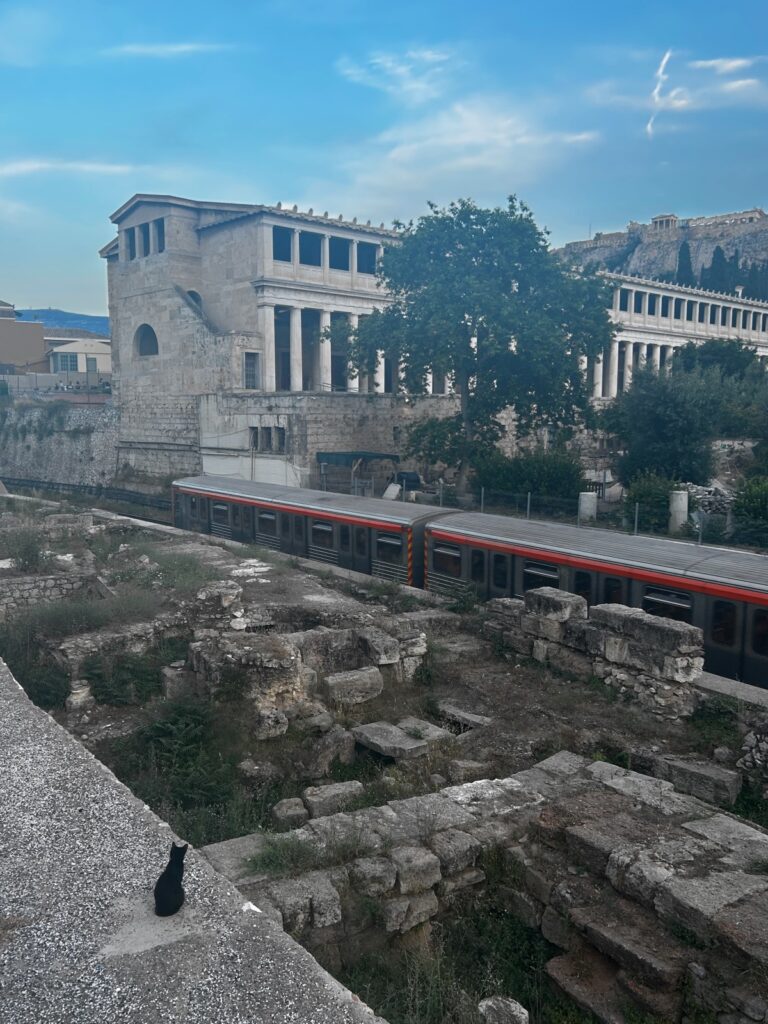
There’s really a lot to see at the Ancient Agora, and it’ll take you at least 1.5 to 2 hours to see it all. Some of the highlights are (but are not limited to):
- Temple of Hephaestus: A well-preserved Doric temple dedicated to Hephaestus and Athena, overlooking the Agora and offering one of the clearest examples of a complete ancient Greek temple.
- Stoa of Attalos: A modern reconstruction of an ancient colonnaded building, now housing the Agora Museum. Inside the museum you’ll find everyday objects from ancient Athens — pottery, tools, and small items that make the city feel less distant and more lived-in.
- Bouleuterion (Council House): The remains of the building where the Athenian council (Boule) met to prepare legislation and political decisions.
- Tholos: The circular building that housed the executive committee of the council, responsible for day-to-day governance.
- Metroon: The former temple of the Mother of the Gods, later repurposed as a state archive for official documents and laws.
- Church of the Holy Apostles: A Byzantine church built in the 10th century directly over earlier classical foundations, representing the site’s later religious use.
- Panathenaic Way: The route of the ceremonial road that ran through the Agora toward the Acropolis during major religious festivals.
- Nymphaeum / Water Supply Installations: Hydraulic structures and channels that helped distribute water through the Agora complex.
3. Temple of Olympian Zeus
- Location: Athens 105 57, Greece (near Syntagma Square and National Garden).
- Opening hours: From 08:00 am – 05:00 pm in winter, and from 08:00 am – 08:00 pm in summer.
- Tickets: Skip-the-line tickets including an audio tour can be purchased in advance here.
The Temple of Olympian Zeus sits just south of the Acropolis and is one of the largest temples from the ancient world.
Builders started the temple in the 6th century BC, but work stopped for centuries. The project only reached completion under the Roman emperor Hadrian in the 2nd century AD, almost 700 years later. He added Corinthian columns and finished it as a statement of imperial power in a city that already had deep Greek roots.
At its peak, the temple held more than 100 massive columns and covered one of the largest sacred spaces in the ancient world. Today, 15 columns still stand, and one lies on the ground where it fell during a storm in the 19th century. The scale still reads clearly when you stand next to it, especially when you notice how small people look beside the remaining stone.
But the best part? Dozens of cats nap in the temple’s hidden nooks and weave through the shadows of its sky-high columns.
4. Hadrian’s Library
- Location: Κ, Areos 3, Τ, Athina 105 55, Greece.
- Opening hours: 08:00 am – 08:00 pm.
- Tickets: You can purchase your ticket with audio guide here.
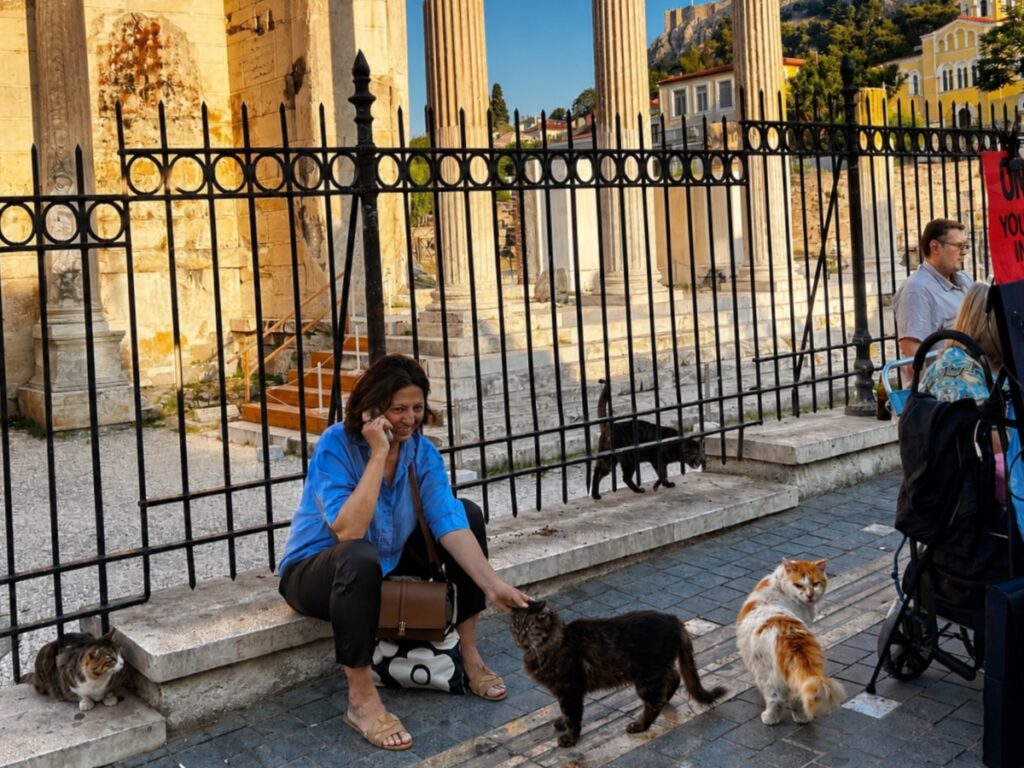
Hadrian’s Library was a center of learning in ancient Athens, and once housed thousands of scrolls and manuscripts. It sits just a short walk from Monastiraki Square.
Today, many stray cats have taken up residence amidst the ruins of Hadrian’s Library. They often sit on broken pillars and arches, watching over the visitors as they explore the site.
Their favorite place? The Tetraconch Church, a Byzantine-era church built later within the ruins of the library complex.
The church takes its name from its unusual layout: four curved apses arranged around a central space. That design was relatively uncommon, which is one reason archaeologists pay attention to it today.
Hadrian’s Library is by far the place in Athens where you’ll find the most cats.
5. Philopappos Hill
- Location: Φυλής 215, Athina 117 41, Greece.
- Opening hours: Open 24/7.
- Tickets: Free.
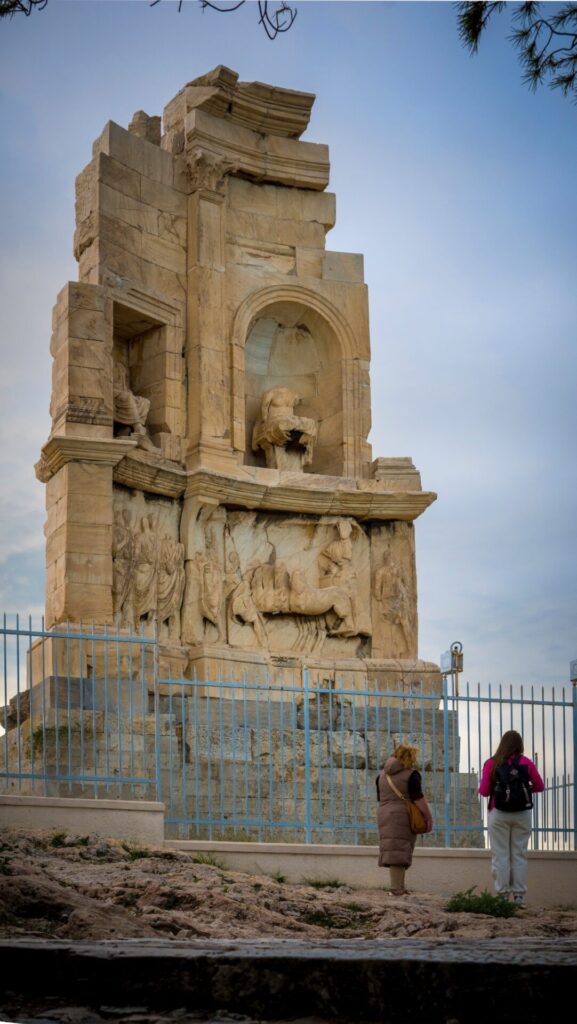
If you want photo-worthy views of Athens, especially around sunset, climb Philopappos Hill. This peaceful green space, also known as the Hill of the Muses, is steeped in mythology and dotted with walking trails, pine trees, and even ancient ruins, like the Monument of Philopappos, built in honor of a Roman prince. It’s the place where locals come to walk their dogs, have a picnic, or catch the sunset.
And yes, you’ll likely pass a few cats on the way up. However, they’re not as bold as the ones in Plaka. Let them nap in peace and keep hiking.
6. Roman Agora (Roman Forum of Athens)
- Location: Polignotou 3, Athina 105 55, Greece.
- Opening hours: 08:00 am – 03:00 pm.
- Tickets: You don’t need a ticket to see the Roman Agora, since you can easily walk around it and view it from the outside. However, if you want to see the cats up close, or if you want more detail, e-tickets that include an audio guide are available.
Built in the late 1st century BC under Julius Caesar and later expanded under Augustus, the Roman Agora used to be a bustling marketplace with shops, storage spaces, and offices.
Now, it lies in ruins near the Plaka District. The most striking surviving feature is the Gate of Athena Archegetis, a tall marble entrance with four columns that still marks the site’s main access point.
Many cats have found a cozy refuge among the fallen columns and weathered stones of the agora. You will probably see many a cat perched on an ancient pedestal or napping in a hidden corner.
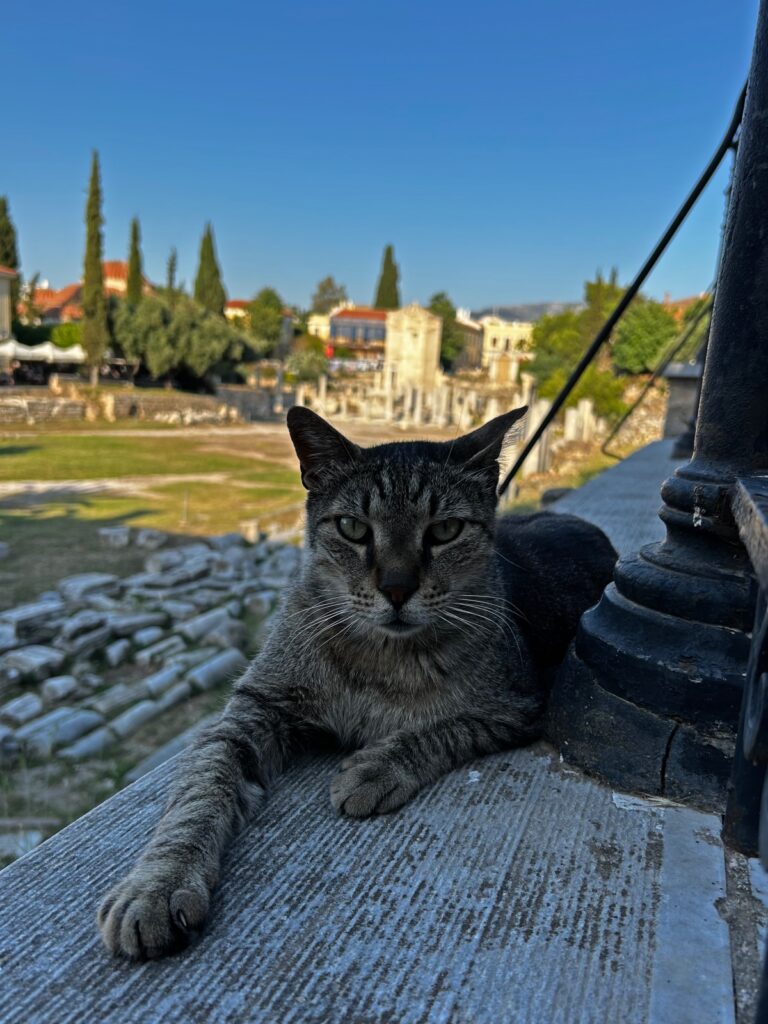
Some other monuments you’ll find at the Roman Agora are:
- Tower of the Winds: An octagonal marble structure that functioned as a combination of sundial, water clock, and wind indicator, and remains the most distinctive monument of the site.
- Gate of Athena Archegetis: A monumental entrance gate dedicated to Athena, marking the formal entry into the marketplace.
- Fethiye Mosque: An Ottoman-era mosque later built within the Roman Agora, reflecting the site’s continued use across centuries.
- Remains of surrounding stoas and shop structures: Fragmentary colonnaded buildings that once formed the commercial edges of the marketplace.
- Open courtyard layout: The central rectangular space that functioned as the main trading area of the Roman-period agora.
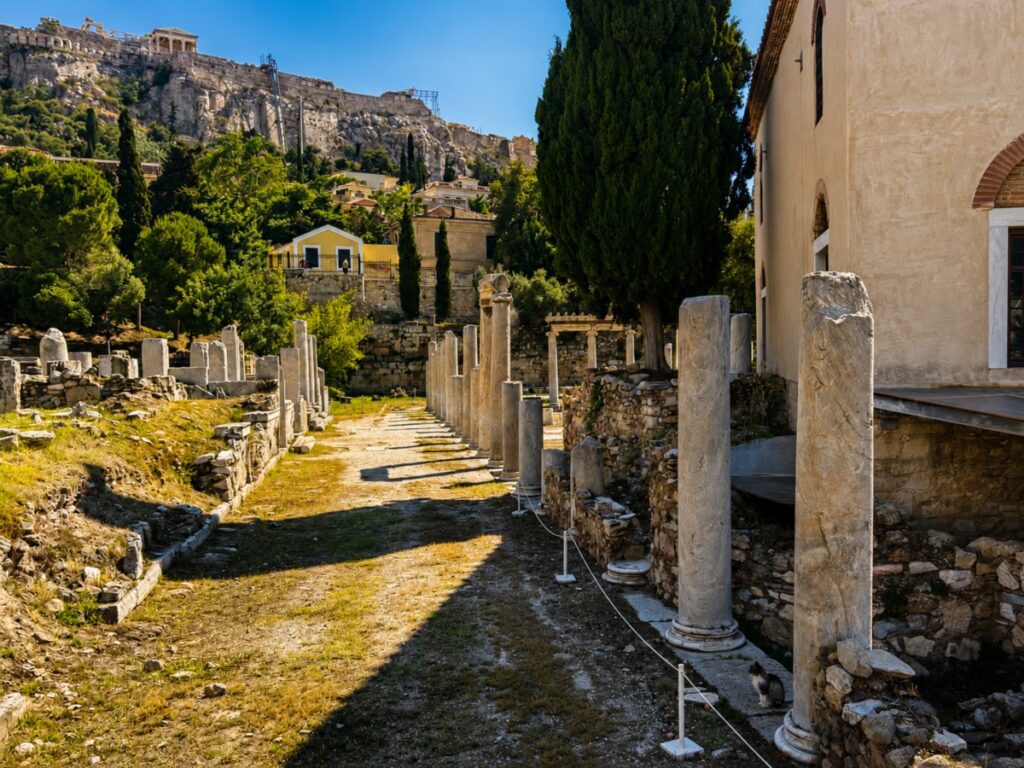
7. Kerameikos
- Location: Ermou 148, Athina 105 53, Greece.
- Opening hours: Temporarily closed.
- Tickets: /
Kerameikos is one of Athens’ most underrated sites… and one of the most beautiful. It used to be the city’s main burial ground for centuries, and today, it’s a peaceful mix of wildflowers, marble tombstones, and archaeological remains that stretch along the ancient city wall.
There’s a small but fascinating museum here, too, with artifacts found on-site.
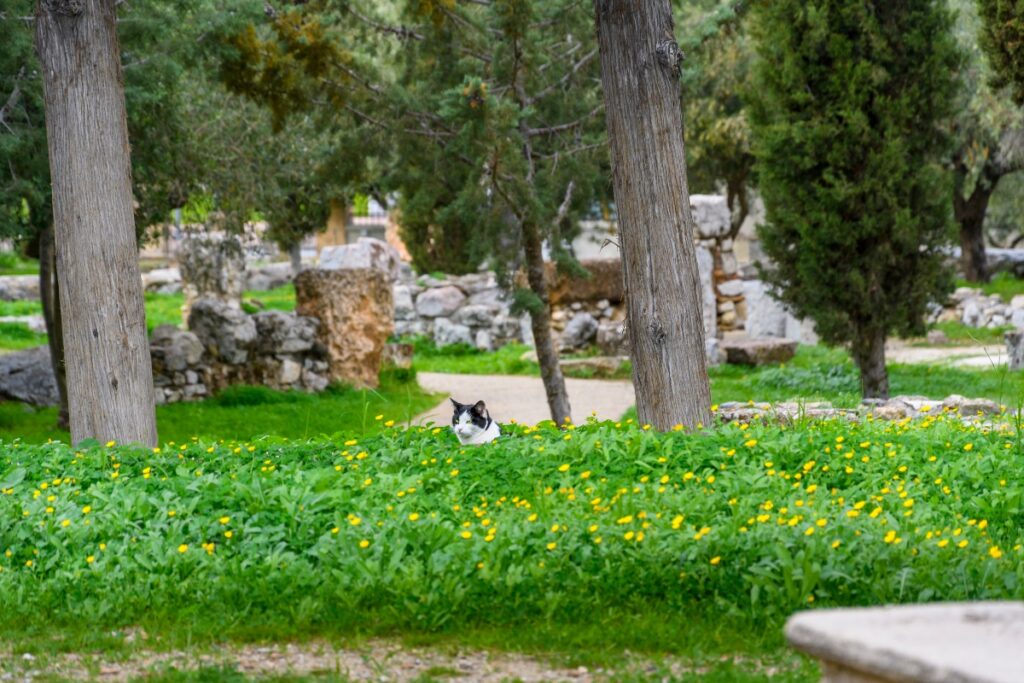
8. Choragic Monument of Lysicrates
- Location: Epimenidou 3, Athina 105 58, Greece.
- Opening hours: Open 24/7.
- Tickets: free.
The Choragic Monument of Lysicrates is tucked into a small pocket of Plaka, along a narrow pedestrian street called Tripodon, which is one of the oldest streets in Athens.
It was built around 334 BC, commissioned by Lysicrates after his chorus won a competition at the City Dionysia festival (because in Athens at the time, wealthy citizens who sponsored these performances were expected to “mark” their victory with a monument).
A Capuchin monastery grew around it in the 1600s and enclosed it, which kept it safe from stone collection and rebuilding projects.
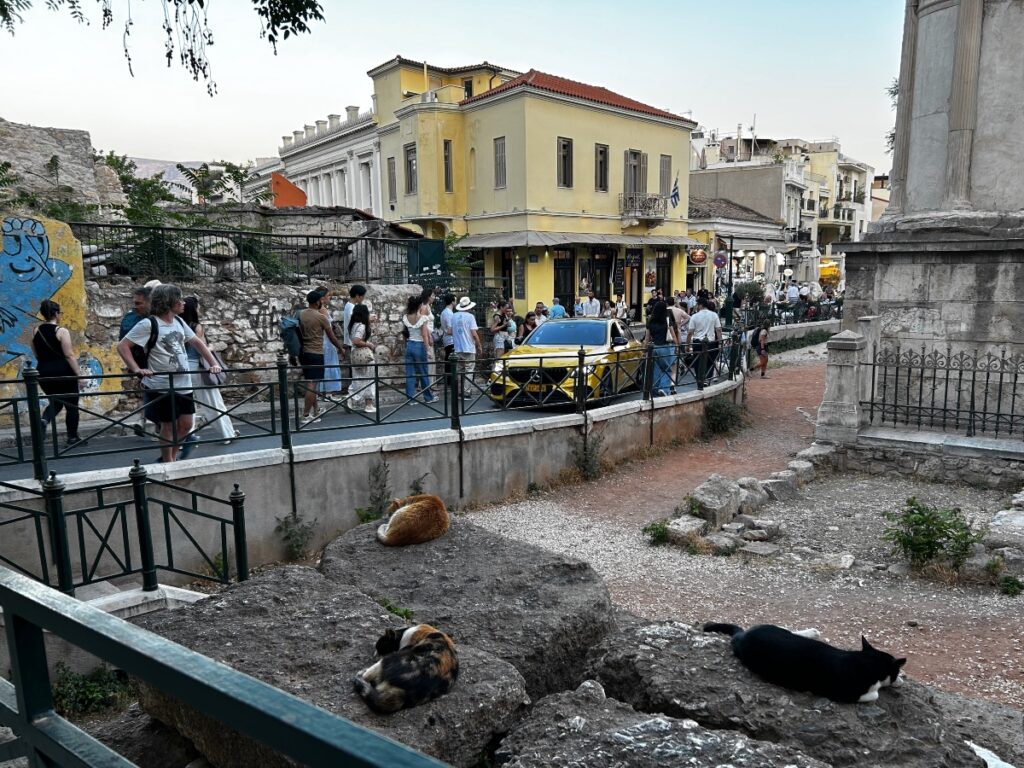
Discover even more historical sites in Athens, Greece
Find a place to stay
Still looking for a place to stay? We love these hotels in Athens because they feed and care for stray cats.
Final thoughts
Have you been to Athens? Where did you spot the most cats? Was it the winding streets of Plaka? Among the ruins of the Roman Agora? Or maybe somewhere totally unexpected? Drop your favorite cat-spotting location in the comments!
If this post gave you the sudden urge to pack your bags and head to Greece, go ahead and share it with your travel buddies and on social media. 🇬🇷🐾
Read next >> Cats and their love for Istanbul’s historical sites: 30 must-see feline attractions.


English version / version française / versione Italiana
Pin these historical sites in Athens, Greece!