Last Updated on 29 September 2026 by Vanessa
A complete look at the Acropolis cats and the legendary site they call home. From the volunteers who watch over them to the places where you’ll be most likely to spot a few felines, this guide tells you everything you need to know about Athens’ most charming residents.
But that’s not all. In this guide, you’ll also find everything you need to plan your visit: opening hours, ticket info, must-see highlights, transport and accommodation options, and even a little bit of history.
📍 Tip: The Acropolis is just one of many places in the city that is teeming with cats. If you’d like to discover more of them, check out my guide to the most famous historic sites in Athens and their feline dwellers.
The Acropolis cats: meet the 500+ felines living around Athens’ most famous landmark

What exactly is the Acropolis?
If you’re planning a trip to Athens—or you’ve spoken to anyone who’s been there—you’ve probably heard the same piece of advice: don’t leave without visiting the Acropolis.
According to The Greek Reporter, the Acropolis is Greece’s most-visited tourist attraction, drawing more than 4.5 million visitors each year.
And it’s easy to see why. Perched high above the city on a rocky hill, the Acropolis dominates the Athens skyline. No matter where you go in the historic center, chances are you’ll catch a glimpse of it.
But what exactly is the Acropolis?
Many people confuse the Acropolis with the Parthenon (I used to do the same), but the Parthenon is just one monument within the larger Acropolis complex.
The word “acropolis” literally means “high city.” Ancient Greeks often built fortified settlements on elevated ground, but when people refer to the Acropolis today, they’re almost always talking about the Acropolis of Athens.
The site has a history stretching back more than 3,000 years, but most of the monuments visitors see today date to the 5th century BC. After the Persian invasion of Greece, the Athenian statesman Pericles launched an ambitious rebuilding program. Over roughly 50 years, skilled architects, sculptors, and craftsmen transformed the hill into one of the most extraordinary architectural ensembles of the ancient world.
Today, the Acropolis includes the following monuments:
- The Parthenon (447–432 BC): The most famous structure on the hill and the symbol of Athens itself. Ancient Athenians dedicated this enormous temple to Athena, the city’s patron goddess. Its elegant columns and perfectly balanced proportions have inspired architects for centuries.
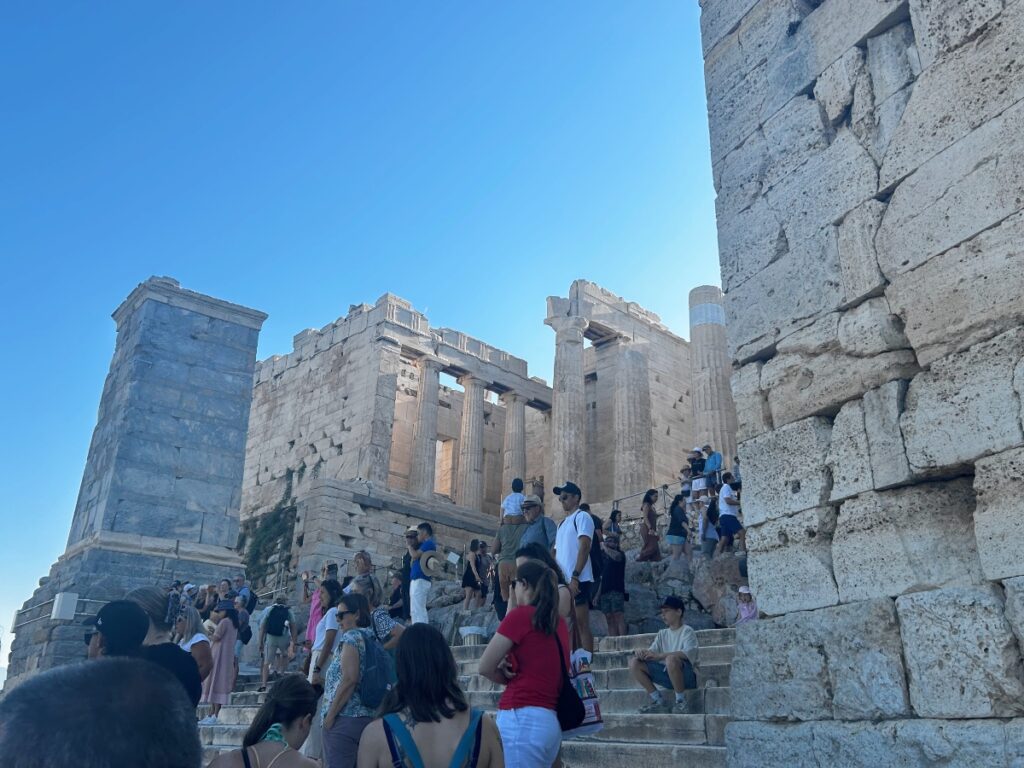
- The Propylaea (437–432 BC): The monumental gateway to the Acropolis. Every visitor entering the complex passes through this impressive structure, which was designed to make a dramatic first impression.
- The Erechtheion (421–406 BC): Known for its famous Porch of the Caryatids, where six sculpted female figures serve as columns. The Athenians built this temple on a site associated with several important myths, including the legendary contest between Athena and Poseidon for control of the city.
- The Temple of Athena Nike (427–424 BC): A small but beautifully designed temple dedicated to Athena in her role as the goddess of victory. It stands near the entrance to the Acropolis and once celebrated Athenian military successes.
- The Theatre of Dionysus (6th century BC, later expanded): Located on the southern slope of the Acropolis, this theater is often considered the birthplace of Greek drama. Ancient playwrights such as Sophocles, Euripides, and Aristophanes premiered their works here.
- The Odeon of Herodes Atticus (AD 161): Although much younger than the Classical monuments above it, this magnificent stone theatre remains one of Athens’ most impressive landmarks. It still hosts concerts and performances today.
Built from limestone and gleaming Pentelic marble, the Acropolis remains a breathtaking sight. Whether you’re admiring it from a rooftop terrace in Athens or from Philopappos Hill, it’s difficult not to feel a sense of awe. After all, these monuments have watched over the city for nearly 2,500 years—and they’re still the first thing most visitors want to see.

The Acropolis cats
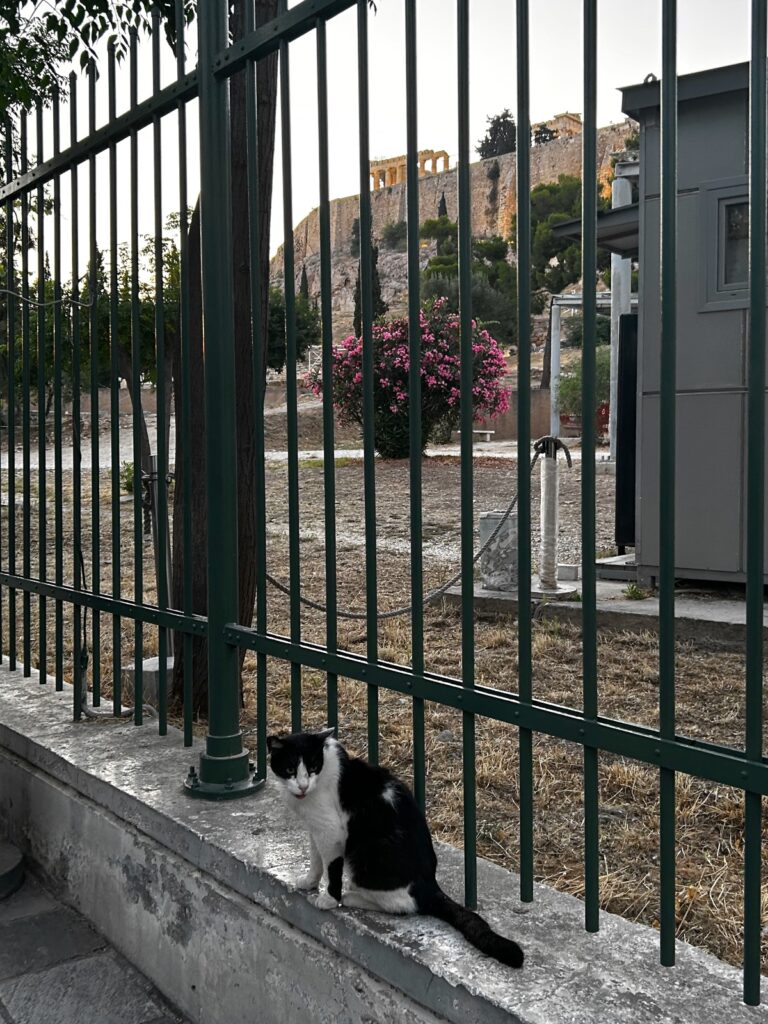
The Acropolis is not just popular with locals and tourists. Cats love it there, too. According to Danae from the welfare organization Nine Lives Greece, more than 500 stray cats have made the Acropolis and the surrounding area their permanent home.
However, while you can sometimes see cats lounging on top of ruins or taking a nap in the shade of an old column, especially near the Propylaea, most of them will hang out on the slopes leading up to the Acropolis as well as in the areas surrounding the famous hill.
Some cats will let you come close enough to pet them. Others will be more reserved, just content to sit in the shade and watch the tourists curiously from a distance.
Why so many cats?
You may have noticed that cats have a particular fondness for ruins. Over the years, I’ve spotted them among the ruins of Delos, the Málaga Roman Theater, around the Colosseum in Rome, beside the Roman aqueduct of Moria on Lesbos, and in countless other historic sites across Europe. The Acropolis is no exception.
Ruins offer cats exactly the kind of environment they prefer: plenty of elevated lookout points, quiet corners, shelter from the sun and the rain, and countless places to retreat when they don’t feel like being social.
The Acropolis is especially appealing because large parts of the ancient temples and monuments are inaccessible to visitors. While thousands of tourists pass through the site every day, the cats can slip into areas where people can’t follow, giving them a safe refuge whenever the crowds become too much.
For a cat, the Acropolis is one of the safest homes in the city.

How Nine Lives Greece cares for the Acropolis cats
Nine Lives Greece, which also goes by the Greek name Oi Eftyxes, meaning “Seven Souls” (because in Greek, they say cats have seven souls, not nine lives, so they use both names) maintains five core colonies around the Acropolis.
Daily monitoring
Danae from Nine Lives Greece told me that volunteers don’t just show up with food and water. Each colony is monitored by an allocated volunteer who tracks individual cats, notices health changes, and reports missing, injured, or new animals through an internal system. They are trained and familiar with the individual cats and their needs.
TNR (Trap-Neuter-Return)
Their aim is to sterilize at least 80% of colony cats in the wider Acropolis area. In doing so, they also offer first aid, veterinary treatment, vaccinations, and anti-parasite treatment.
Nine Lives Greece also provides financial support to volunteers maintaining colonies near their homes or workplaces, and they assist with TNR and medical expenses whenever possible.

Adoption
The organization also runs a small foster and adoption program through which they place vulnerable cats and kittens in temporary care and work to find them safe, permanent homes.
International adoptions are possible, and adopting a cat from Greece is actually a straightforward process (you can learn more about that here).
Nevertheless, Nine Lives Greece will be happy to guide you through the process step-by-step if needed.
Lending a helping paw
“We are currently the only registered organisation consistently supporting the cats in the Acropolis area in a structured manner,” Danae from Nine Lives Greece explains. “That said, there are individual caregivers and local residents who are kind, attentive, and often collaborate with us. In the wider Acropolis area, around 200 cats receive daily feeding from volunteers, while others rely on long-term local residents who look after specific colonies close to where they live or work.”
“It is one of the few areas of Athens with such a large number of cats with many of them being elderly,” Danae says. “That is both a testament to the success of our program and a responsibility that requires ongoing, dedicated care.”
Donations
If you want to help, donations make a direct difference and go toward food, veterinary care, sterilization, and medication.
You can contribute as a one-time donor or set up a monthly contribution through the Nine Lives Greece website.
Monthly support is especially valuable because it gives the organization predictable resources to plan ahead. Here’s what different contribution levels typically support:
- €5/month → one anti-parasite treatment for one cat
- €15/month → medication for a stray cat in need
- €25/month → feeding support for one colony
- €50/month → helps cover the cost of spaying or neutering one cat
As you can see, even small monthly donations stack up quickly when they support hundreds of animals across multiple colonies.
Other ways to get involved
Not everyone can donate money, and that’s ok. Nine Lives Greece actively relies on time, skills, and hands-on help as well. Here are a few other ways in which you can support the organization:
- Fostering cats: By fostering, you give vulnerable cats and kittens a safe space to recover and socialize before adoption. The organization covers all medical and basic care costs.
- TNVR and rescue work: You are also welcome to help with trapping, neutering, vaccination, and return programs to keep colonies stable and healthy.
- Transport support: Even occasional help with getting cats to veterinary appointments makes a real difference, especially in emergency situations.
- Social media and awareness: Sharing this article and other stories about Nine Lives Greece helps increase visibility, which directly supports adoption rates and donation levels.
- Website and design support: If you have digital skills, you can help with updating website content, creating visuals, and maintaining online resources.

Can tourists feed the Acropolis cats?
“While feeding is not prohibited, we recommend that visitors contact us and join one of our guided feeding rounds instead,” says Danae from Nine Lives Greece. “Some of the cats follow special diets, receive medication, or require supplements. Sporadic feeding can interfere with their treatment, so coordinated feeding is always in the cats’ best interest.”
This system ensures that each cat receives the right food at the right time. It also prevents health issues that can arise when well-meaning visitors unknowingly disrupt medical routines.
For travellers, the takeaway is simple: the cats are already being cared for. The best way to help is not by improvising, but by supporting the structure that already exists.
Learn more about the stray cats of Athens
Did you know that you can go on a Cats of Athens Walking Tour?
It takes you through the Thissio neighborhood of Athens, and while you meet all the feline locals, you’ll learn more about their lives and struggles and about the efforts made to protect them.
All proceeds go directly towards feeding, neutering, and caring for them.
You can book the Cats of Athens Walking Tour here. It’s one of the best (and most enjoyable) things you can do to help support the cats of Athens.
Not sure if this one’s for you? Then read my review of this Athens walking tour first.

Visit the Acropolis: practical info about tickets, tours, opening hours, hotels, and more
Ready to explore the Acropolis and say hello to its famous cats? These quick tips will help you make the most of your visit.
Tickets
Greece limits daily entry to the Acropolis to 20,000 visitors, so you must reserve your visit in advance here.
Don’t wait because the site fills up quickly. If you try and book a day in advance, tickets may not be available anymore.
Each reservation gives you a 30-minute window to enter—15 minutes before your slot and 15 minutes after.
Do you need an Acropolis ticket to see the cats?
No. Many of the most active cat colonies are on the slopes and outside the paid entrance area.
At roughly €30 per entry in peak season, it’s worth being honest about what you’re prioritizing before buying a ticket. If your main motivation is cats rather than the Parthenon complex, you can simply walk alongside the complex.
Opening hours
April to October:
- Monday to Sunday: 08:00 am to 08:00 pm
- Last admission: 07:30 pm
November to March:
- Monday to Sunday: 08:30 am to 03:00 pm
- Last admission: 02:30 pm
Best time to visit
If you’d like to avoid the worst of the crowds, plan your visit for opening time or during the last hour before closing. The Acropolis is one of Europe’s most popular attractions, and tour groups start arriving surprisingly early. By nine, the site is already teeming with tourists, especially during the peak travel season.
These quieter hours are also your best chance of spotting the cats.
Like many Athenians, the Acropolis cats aren’t particularly fond of crowds or extreme heat. As visitor numbers increase and temperatures climb, many retreat to shaded corners, hidden pathways, and areas of the site that tourists can’t access. Arriving early in the morning or later in the evening gives you a much better chance of seeing them out and about before they disappear for a few hours of peace and quiet.
Getting there
The closest station is Acropoli metro station on the red M2 line. From there it’s just a 2- to 5-minute walk to the Acropolis entrance.
You can also use the green M1 line or blue M3 line, get off at Monastiraki or Thissio, and walk 10–15 minutes to the site.
Bus lines 230, 035, 040, 550, A2 also stop close to the Acropolis.

How much time do you need to see the Acropolis?
A typical visit to the Acropolis usually takes around 1.5 hours.
The Acropolis Museum
There’s not much information available on site, so visiting the Acropolis Museum beforehand will give you an understanding of the history and culture behind the Acropolis, which is important to truly appreciate its architectural brilliance.
📍 Tip: If you’re planning to visit both the Acropolis and the Acropolis Museum, it’s worth purchasing a combo ticket instead of buying your tickets separately.
The combo ticket costs €34, while separate tickets would set you back €56 in total (€30 for the Acropolis and €26 for the museum). That’s a saving of €22 per person for two attractions that most visitors end up seeing anyway. You can buy your combo ticket in advance here.
Restrictions
To help preserve the Acropolis and ensure the safety of visitors, certain things are not allowed, including:
- Food and drinks (apart from a bottle of water)
- Cigarettes
- Pets
- Large bags and backpacks
- Tripods and professional photography equipment
- Drones
Also, visitors are not allowed to lean, climb and sit on the ancient artifacts and structures to prevent wear and tear. They are expected to maintain a respectful and quiet atmosphere on the Acropolis to preserve the tranquility of the site.
The Acropolis by night
Seeing the illuminated Acropolis after dark is what will really make you fall in love with Athens. While you’ll have great views from many spots around the city center, a few places stand out above the rest.
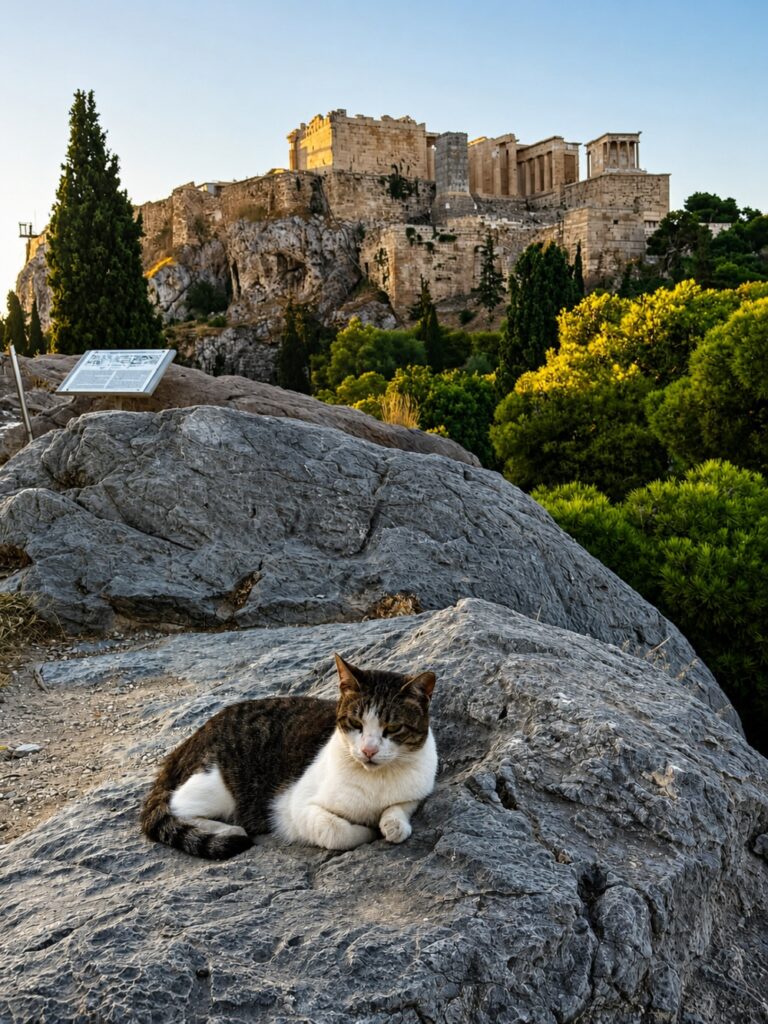
Philopappos Hill
For the best view in Athens, head to Philopappos Hill. The walk to the top is easy and takes about 15–20 minutes, covering roughly 600 meters (0.4 miles), depending on where you start.
The hill is right next to the Thissio neighborhood, which is full of restaurants and cafés. Time your visit for sunset if you can: the view of the Acropolis as the city lights begin to come on is unforgettable.
Thissio
Thissio is one of the best Athens neighborhoods for Acropolis views. Many cafés, bars, and restaurants have outdoor seating facing the illuminated hill, making it a perfect place for dinner or drinks.
This neighborhood also has a high concentration of community cats. Cat Café Athens is also located here.
Rooftop bars and restaurants
Many rooftop bars and restaurants in Athens are known for their Acropolis views. Try at least one during your stay.
However, be aware that the most spots can get very crowded, especially around sunset. If you prefer something quieter, consider dinner at Strofi, but make sure to reserve your table in advance.
Acropolis view hotels
If your budget allows, choose a hotel with Acropolis views. The closer you stay to the historic center, the better the views.
I stayed at the Acropolis Select Hotel in Koukaki, which has a rooftop terrace overlooking the Acropolis. Being able to step outside and see the monument lit up at night was a welcome bonus.
Check prices and availability: Booking.com / Agoda
Otherwise, here are a few other hotel options in Athens:
- Divani Palace Acropolis: This luxurious hotel offers stunning views of the Acropolis and is just a 5-minute walk from the entrance. Address: 19-25 Parthenonos, Athens.
- Electra Palace Athens: Situated in the Plaka neighborhood, this elegant hotel is within a 10-minute walk from the Acropolis. Address: 18-20 N. Nikodimou Street, Athens.
- Herodion Hotel: Located right at the footsteps of the Acropolis, this charming hotel provides easy access to the historical site. Address: 4 Rovertou Galli Street, Athens.
- Amalia Hotel Athens: Situated in the heart of the city, this hotel is a short walk away from the Acropolis and offers breathtaking views of the site. Address: 10 Amalias Avenue, Athens.
- Airotel Parthenon: Enjoy the convenience of being steps away from the Acropolis at this modern and comfortable hotel. Address: 6 Makri Street, Athens.
- AthensWas Hotel: This contemporary boutique hotel is located near the Acropolis Museum and provides easy access to the Acropolis. Address: 5 Dionysiou Areopagitou Street, Athens.
- New Hotel: Designed by famous Brazilian Campana brothers, this unique hotel is around a 10-minute walk from the Acropolis. Address: 16 Filellinon Street, Athens.
Read more about the Acropolis cats
Have the Acropolis cats stolen your heart? If so, there are several travel and photography books that have dedicated entire chapters to them.
- Street Cats and Where to Find Them by Jeff Bogle
- Cats of the World by Hannah Shaw and Andrew Marttila
- Cats of Greece and Scenic Places by Marisa Meisters
Traveling with children? Then KeeKee’s Big Adventures in Athens, Greece is worth a look. This illustrated travel book introduces young readers to Athens through the eyes of an adventurous cat, making it a fun way to spark their interest in both the city and its feline residents before your trip.
If this article helped you plan your visit (or made you want to add the Acropolis to your bucket list), feel free to share it with someone who needs a little more cats in their travel plans.
Got more time to explore Greece? These best day trips from Athens are worth adding to your itinerary.

English version / version française / versione italiana
Pin these Acropolis cats!