Last Updated on 4 January 2024 by Vanessa
Cats have traversed the annals of British history, silently observing and influencing the course of many historical events.
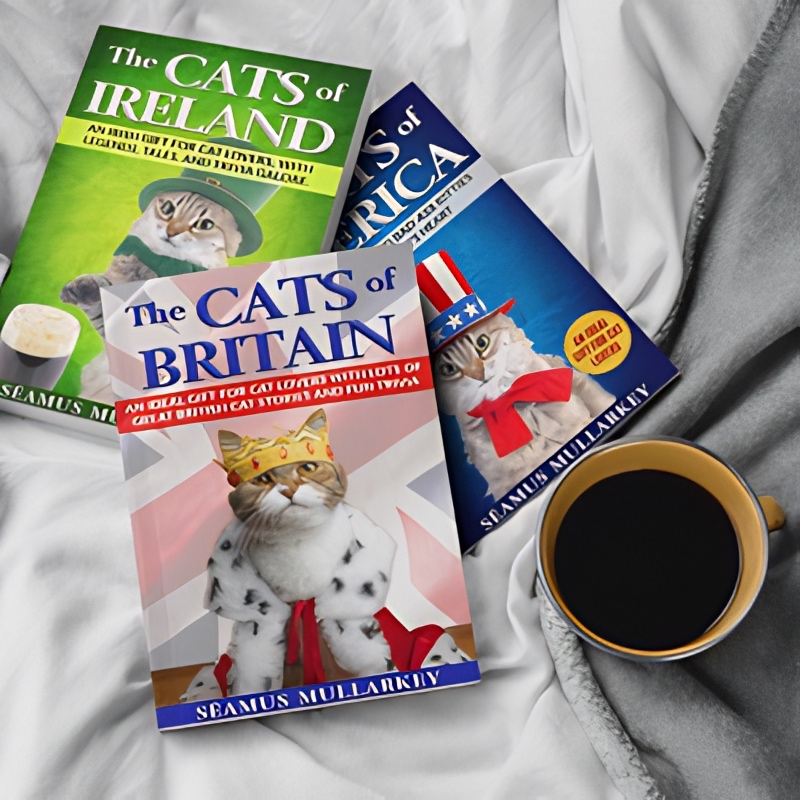
The Cats of Britain by Seamus Mullarkey is a book that that spills the beans on how our feline friends impacted England’s past, shaped folklore, and became pub legends. From Roman invasions to royal courts, this book purr-fectly captures the enduring bond between Brits and their whiskered companions.
Here’s a look at some of the most interesting themes the book covers.
The Cats of Britain by Seamus Mullarkey

Cats as silent witnesses: from Londinium to the Great Fire of London
The book puts a lot of emphasis on history and the role of cats therein.
For example, as the Roman legions invaded Britain in 43 AD, they brought along their feline companions to assist in controlling the burgeoning rat population in newly established cities like Londinium.
These resourceful cats also played a crucial role during historical events such as the Norman invasion of 1066 and even weathered the storm of the Black Plague.
Unfortunately, superstitions against them – mainly their associations with witches and others close to the devil – proved detrimental to the poor cats.
Eventually, their value became apparent again, as the destruction of cats led to a spike in flea and rat populations.
Nowadays, there are more than ten million pampered cats in Britain.
Cats in folk tales and nursery rhymes
In The Cats of Britain, Mullarkey shows us that the heart of British culture beats to the rhythm of cat lore found in folk tales and nursery rhymes.
The enduring Hickory Dickory Dock, where a cat resides in a clock, imparts values of patience and hard work to children.
Ding Dong Bell, dating back to the 17th century, advocates kindness toward cats and condemns cruelty.
Over time, folk tales and nursery rhymes became children’s books, musicals, and more.
Beatrix Potter’s children’s book The Tale of Ginger and Pickles (1909), for example, is set in a fictional village where a cat named Ginger and a dog named Pickles run a small shop together.
Meanwhile, the renowned musical Cats by Sir Andrew Lloyd Webber and based on T.S. Eliot’s Old Possum’s Book of Practical Cats, features a group of Jellicle cats who gather for an annual event where one cat is chosen to ascend to the Heaviside Layer and be reborn.
The first cat shows: Winchester in 1598 and the Crystal Palace in 1871
From the groundbreaking exhibition in Winchester in 1598 to the first National Cat Show at the Crystal Palace in 1871, the book sheds light on the efforts to recognize and celebrate the diverse breeds of cats and on the role Harrison Weir, the organizer of the Crystal Palace show, played in elevating the status of cats as domestic animals.
Pub cats of Britain
Of course, it’s impossible to publish a book about cats in Britain without mentioning the country’s famous pub cats.
Pubs (short for public houses) are synonymous with British culture and have a longstanding tradition of featuring cat imagery on their signs. From “The Cat and the Fiddle” to “The Cat With No Tail,” these signs pay homage to the feline friends that once roamed the establishments.
But there are many pubs with resident cats, too.
The Bag of Nails in Bristol even boasts 24 resident cats (you can read more about the cats of The Bag of Nails in Bristol here).
Strangely enough, the book doesn’t mention any other famous pub cats such as Legz from the Charlotte Despard, Lily from the Anglesea Arms, and Church from The Old Eagle Pub.
Cats in royal courts: from Henry VIII’s court to Elizabeth I’s coronation procession
The royal courts of Britain have a long history of both lavish and not-so lavish treatment toward feline companions.
Henry VIII, for example, reportedly commissioned a suit of armor for his cat Dagobert, while Cardinal Wolsey, a principal advisor to Henry VIII, was said to bring his cats to formal occasions.
Howell the Good, the most prominent king of medieval Wales, even implemented laws governing the value of felines. According to these laws, a kitten’s value, from birth to eye-opening, was a penny – equivalent to two dozen two-pound loaves of good bread. As the kitten matured to mouse-hunting age, its worth doubled to two pennies. A cat adept at controlling rodents was valued at four pennies, nearly equivalent to an entire pig under Howell’s rule.
On the other hand, the coronation procession of Elizabeth I featured a wicker representation of the Pope filled with live cats, reflecting the superstitious beliefs surrounding cats at that time.
Conclusion – Is The Cats of Britain worth your time?
As you might have noticed from the themes mentioned above, The Cats of Britain was an interesting and diverse read and a significant improvement from Mullarkey’s earlier book, The Cats of Ireland, which was superficial and filled with lazy jokes.
Unfortunately, the book does include many chapters that have little to do with our feline friends. The author seems to have included everything he found that vaguely mentioned a cat, resulting in chapters dedicated to entirely different subjects with only a brief mention of a furry companion. For example, there’s a chapter on the Brits’ love for gardening in which Mullarkey only briefly mentions that cats love to sleep in gardens and that monks used to cultivate catnip for use by humans.
At the same time, the book is not at all comprehensive. There are many more famous cats, literary mentions, cat cafés, cat statues, etc., that could have been more interesting to discuss than the chapters that are only vaguely related (the cats of Highgate Cemetery, for example, or the cat that greets all the commuters at Gipsy Hill train station in London, Louis the Wells Cathedral cat, or the viral shop cats from Southampton, Tiverton, and Saltney).
Despite its shortcomings, I did enjoy reading The Cats of Britain, and I eagerly anticipated diving into it whenever I had the chance. It could be an excellent gift for a cat-loving child or teenager if you want to educate them about British history as well. However, I’ve only read the Kindle version, so I can’t comment on the quality of the hardcover edition.
By the way, Mullarkey has published numerous other books about cats, which you can explore here.
The ultimate cat lover’s guide to London: 25+ cat-themed activities for a purr-fect trip (2023)