Last Updated on 11 January 2026 by Vanessa
With St. Patrick’s Day approaching, what could be more fitting than a list of over 30 interesting facts about cats in Ireland?
From local folklore and contemporary feline Internet sensations to tales of Irish castles teeming with cats, these facts are bound to give you plenty to talk about on this festive occasion.
By the way, while St. Patrick’s Day seems to be taking center stage in everyone’s world, it’s worth noting that March 17 is also St. Gertrude’s Day. This is an occasion that’s even more important for us cat lovers because Saint Gertrude of Nivelles is the patron saint of cats. This Belgian nun was born in the 7th century and became the abbess of the Abbey of Nivelles. Her connection to cats stems from historical accounts that suggest she and her fellow nuns kept feline companions to help control the population of mice and rats in the monastery.
So, now that you know that Saint Patrick’s Day is also when we celebrate cats, let’s jump right in and explore the charming world of Ireland’s feline population.
30+ interesting facts about cats in Ireland

Wild cats of Ireland
There’s evidence that wild cats used to roam around Ireland way before our regular house cats showed up. These wild cats are gone now, and they aren’t the ancestors of the cats we have at home either.
The arrival of the domestic cat
The exact arrival time of domestic cats in Ireland is uncertain, but each wave of new settlers and invaders brought cats with them.
Cats proved beneficial in controlling hungry rodents, particularly during grain harvests. An archaeological discovery in County Kildare’s Ballyvass revealed cat bones near an ancient kiln used for drying cereal, suggesting their role in protecting grain.
Whiskey distiller Jameson and stout producer Guinness have also employed cats to safeguard the grains essential for alcohol production.
Black bog cats
Many Irish gift shops sell figurines in the likeness of a black bog cat. These lucky charms originate from legendary large black cats that prowled the shores of Loch Neagh. According to legend, those who happened upon them were bestowed with good luck. Therefore, if you buy one of these charms, they should bring you the same good fortune.
Cait Sidhe, The Cat Kings
The Cat Kings, referred to in Gaelic as cait sidhe (pronounced caught shee), translates to fairy or spirit cats.
They are seemingly ordinary felines – large black cats with a distinctive blaze of white fur on their chests. But legend had it that during Samhain, the precursor to Halloween, the supernatural and earthly realms intertwine and more cait sidhe visit us.
It is customary on this night to leave out a saucer of milk for these otherworldly furry beings. Those who show kindness to them can anticipate gratitude and good fortune in return for the coming year.
The nine cats of Belfast Castle
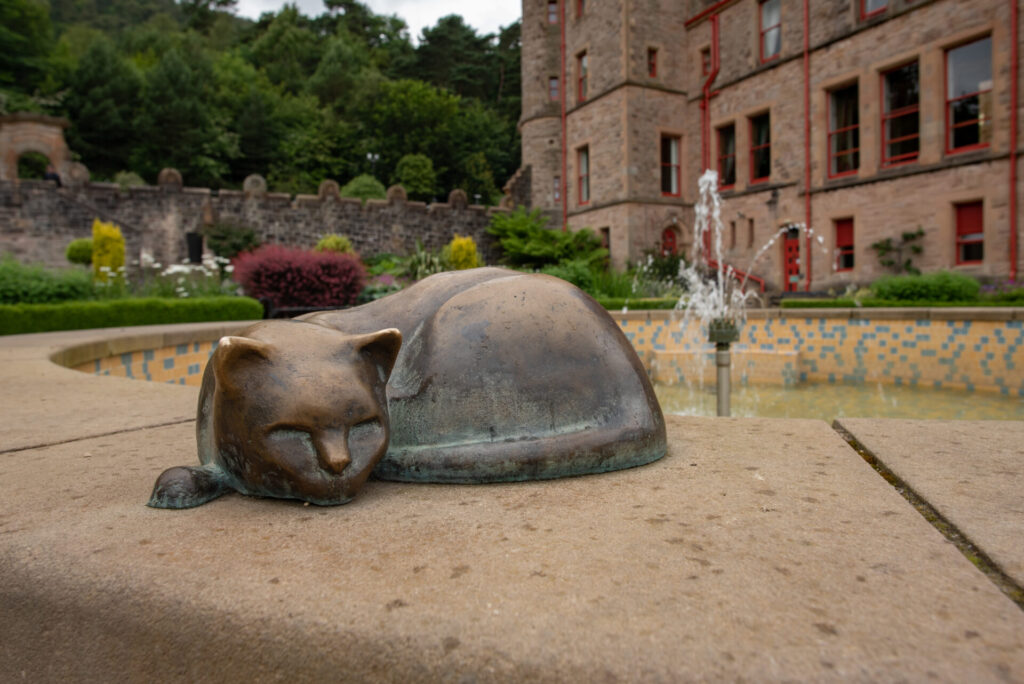
Belfast Castle stands proudly on a hill, giving a great view of the city. This fortified structure has been around since the 12th century, sitting on Cave Hill. The current building was built in the 19th century and is a solid and architecturally distinct structure that you can now rent for events.
According to legend, having a white cat in the castle brings good luck. In keeping with this tradition, there are nine cats featured in different styles as part of the decor. These nine elements symbolize the nine lives of cats.
The Leprechaun’s Cat
Irish folklore is rich with tales of leprechauns, mischievous fairy-like beings famed for their gold and shoemaking prowess. Unfortunately, non of these narratives actually include any cats. To make up for this, Jonathan Emmett and Caroline Jayne Church combine both subjects in a children’s book called The Leprechaun’s Cat.
Feline weather predictors
In Irish folklore, cats were believed to possess weather-predicting abilities. A common superstition held that if a cat was seen washing its face, rain was imminent.
The Cave of the Cats
Rathcrogan is an archaeological complex in County Roscommon, comprising various ancient structures, including ring forts, holy wells, standing stones, and caves. Known as Uaimh na gCait in Gaelic, or the Cave of the Cats in English, this mystical site is believed to be a gateway to the Irish Otherworld and the realm of Morrigan, the Celtic goddess of battle and strife.
According to a 10th-century tale, the legendary warrior Cuchulainn and his two comrades underwent an initiation ceremony within these caves, where their courage was tested by formidable cats. Folklore suggests that one might hear an otherworldly feline wail within the walls of this cave.
Pangur Bán
Pangur Bán is the central feline figure in a ninth century poem written by an Irish monk who lived in Carinthia, Austria. The poem is dedicated to his beloved feline companion and reflects on the similarities between the monk’s scholarly pursuits and his cat’s diligent mouse-catching activities. The poem was found in the margins of the holy book, the Reichenau Primer.
Pangur was a popular cat name at the time, and Bán is the irish Gaelic word for white.
The story of Pangur Bán has since been retold in the children’s book Pangur Bán: The White Cat and the Monk by Jo Ellen Bogart and Sydney Smith.
Dingle’s Instagram sensation
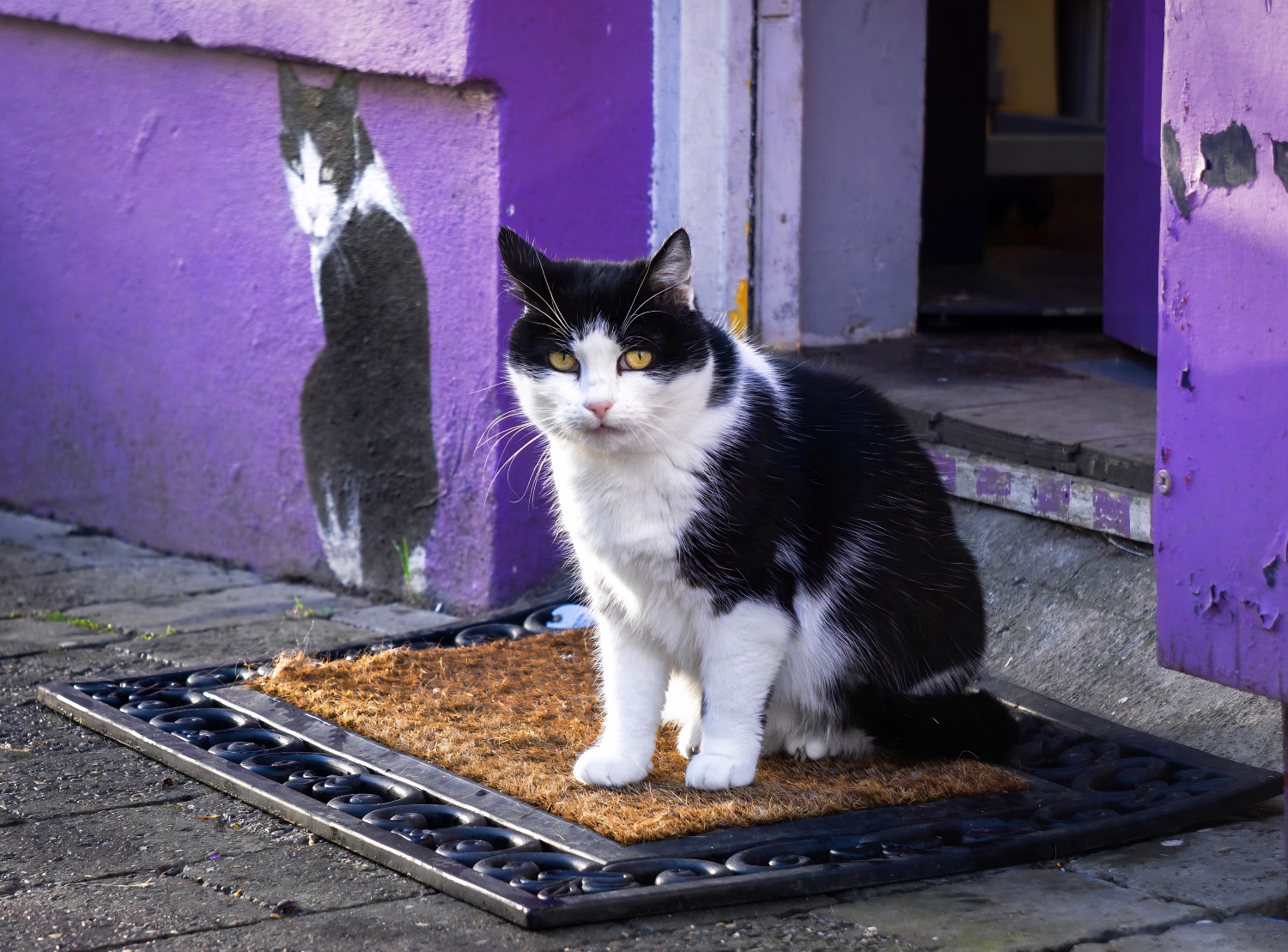
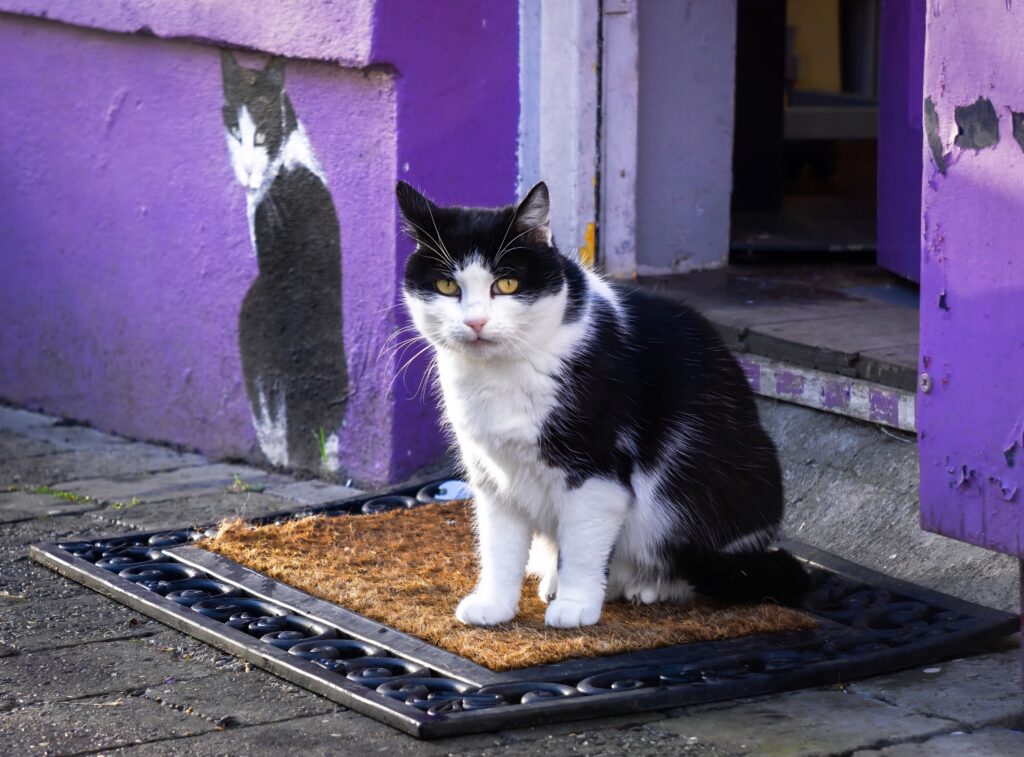
Dingle in County Kerry has a feline Instagram sensation called Angel. This chubby black-and-white cat can often be found lounging next to a mural at the Sweet Pea gift shop. The mural is a precise representation of her, turning both Angel and her artistic portrayal into a picturesque and Instagram-worthy attraction.
Matt Moore’s famous felines
During the silent era, Irish actor Matt Moore starred in 221 movies from 1912 to 1958. Renowned for his fondness for pets, he often brought his cats onto the set, successfully convincing directors to include them in movie roles. Two of his feline companions even earned stars on the animal section of Hollywood’s Walk of Fame.
Oscar the seafaring cat
A black cat named Oscar from Belfast had a truly remarkable maritime history and used up several of his nine lives to survive sinking ships.
Oscar’s first adventure was aboard the German battleship Bismarck during WWII, which was ultimately sunk by the British Royal Navy. Rescued by the British vessel HMS Cossack, Oscar earned the nickname “Unsinkable Sam.” He escaped once again and chose a new home aboard the British HMS Ark Royal. When that vessel was torpedoed and sank one month later, he found himself in the care of the crew on HMS Legion.
Oscar then retired from his seafaring days and spent the rest of his life on dry land.
Stevie, the blind mountaineering cat
Carrauntoohil, standing at 3,406 feet, is the tallest mountain in Ireland. In 2016, Patrick Carr and his blind mountaineering cat, Stevie, undertook a remarkable ascent to raise funds for animal charities and spotlight the uniqueness of all cats, regardless of physical handicaps. The ascent, accomplished in approximately four hours, saw Stevie navigating on a leash and perching on his owner’s back during the journey.
Bodacious The Shepherd Cat
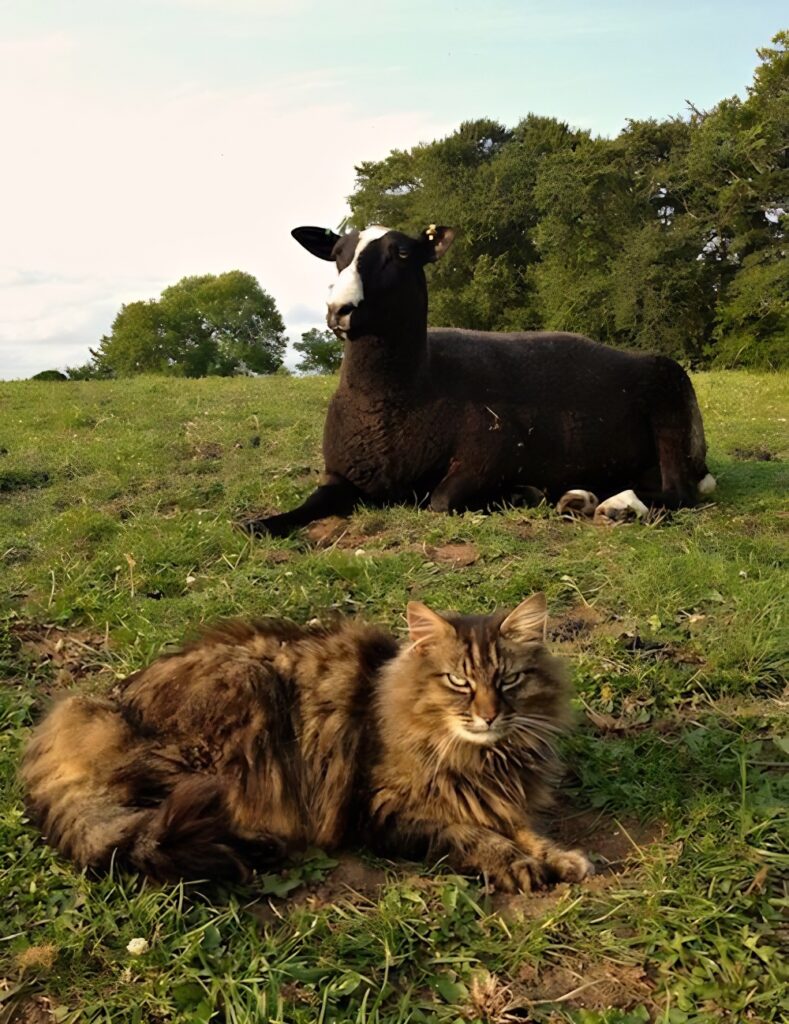
Ireland has a shepherd cat named Bodacious, a gray fluffy rescue who spent over 11 years on Suzanna Crampton’s sheep farm near the banks of the River Nore in County Kilkenny. Bodacious accompanied Suzanna everywhere on the farm, helping her herd the sheep. Recognzing his uniqueness, she dedicated a Twitter account to this special cat, which quickly attracted nearly 20,000 followers. HarperCollins later published a book about him, titled Bodacious, The Shepherd Cat. Sadly, Bodacious passed away on February 1, 2019.
Cats waiting for Godot
The Irish playwright, novelist, and poet Samuel Beckett often featured in photos alongside his cherished feline companions, their mutual affection evident in the poses and attitudes they assumed.
Although cats are not explicitly mentioned in any of Beckett’s works, some speculate that his most famous story, Waiting for Godot, featuring three protagonists in garbage cans, may bear a connection to alley cats.
James Joyce’s love of cats
The Irish modernist writer and poet James Joyce was a self-proclaimed cat enthusiast, and his feline friends have often been featured in his work. The opening dialogue in Ulysses, for example, involves the protagonist Leopold Bloom engaging with a hungry cat.
Joyce also wrote letters to his grandson Steven, recounting cat tales that were subsequently compiled into The Cat and the Devil and The Cats of Copenhagen.
The President’s Cat
The President’s Cat is a children’s book penned and illustrated by Peter Donnelly. The story unfolds as a small feline companion is unintentionally left behind in Kerry when its forgetful presidential owner returns from vacation. Throughout the narrative, various Irish individuals lend a helping hand to guide the cat back to its rightful home at Áras an Uachtaráin, the presidential residence. The illustrations showcase iconic landmarks like the Rock of Cashel, Dublin Zoo, and Glendalough, providing a unique perspective through the eyes of this courageous little cat.
The cat-shaped rock formation of the Hill of Uisneach
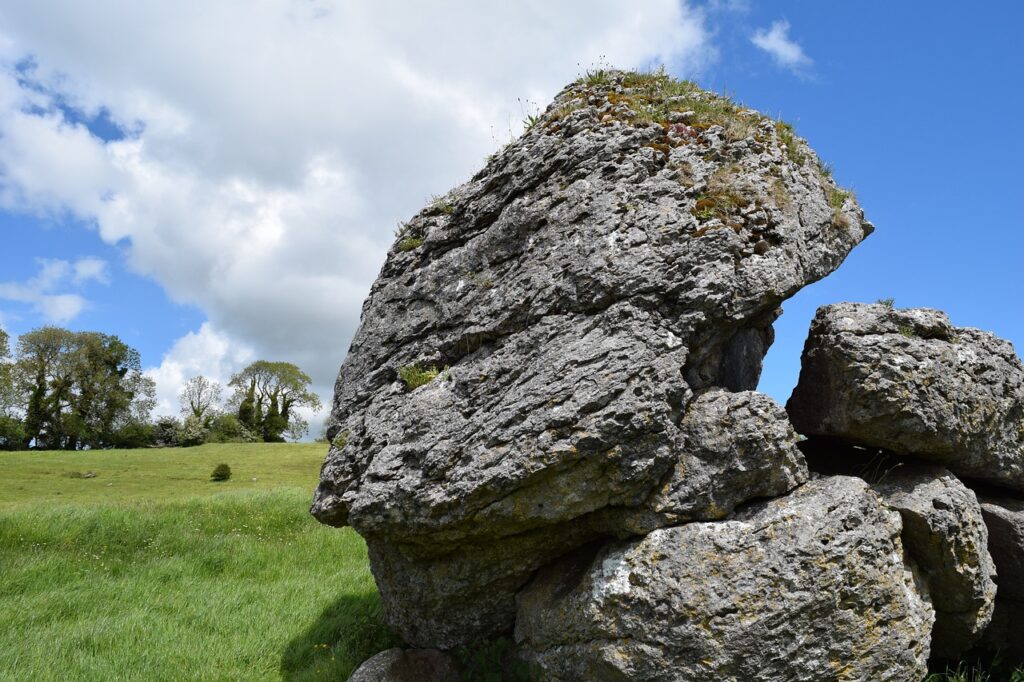
The Hill of Uisneach in County Westmeath is an ancient and sacred site in Ireland, believed to be the burial place of Eriu, the ancient goddess from whom the island of Erin draws its name—Erin being the historical term for Ireland. The place can be recognized by two unusual stones that some say look like a cat chasing a mouse.
Enya’s castle
The imposing Manderley Castle in South County Dublin is located next to Bono’s retreat, surrounded by hefty nine-foot-thick stone walls, and serves as both a home for the reclusive singer Enya and a sanctuary for her menagerie of up to a dozen cats.
The cats with two tails of County Tipperary
In County Tipperary, you’ll come across carvings featuring a cat with two tails, which can be traced back to a legendary figure known as Goban Saor.
During the construction of Ireland’s numerous churches and monasteries, groups of wandering masons and carvers would travel the countryside, setting up temporary camps as they worked on various sites for extended periods. Goban Saor, a skilled stonemason, was once challenged by a monastery abbot to prove his prowess by sculpting a cat with two tails overnight. The next morning, the complete sculpture stood as evidence, but the enigmatic Goban Saor had vanished.
Following this tale, other stonemasons began carving the cat with two tails in hidden corners and on buildings throughout County Tipperary. Even contemporary sculptor David Gorey drew strong inspiration from Goban Saor’s cat with two tails, incorporating these motifs into his artwork.
Kilkanny cats
Kilkenny, in central Ireland, boasts medieval streets that are bound to enchant even the most seasoned of visitors. The town is associated with the Irish expression “to fight like Kilkenny cats,” and its local sports team has been given the same name.
The origin of the phrase harks back to a dark period when British soldiers stationed outside the town were notorious for cruelly tying together cats’ tails, deriving brutal pleasure from watching these unfortunate animals fight each other.
Oscar Wilde’s cat
Oscar Wilde was an Irish playwright, poet, and author known for his wit and flamboyant style, with one of his notable works being The Picture of Dorian Gray. Legend has it that he once found a cat peacefully asleep on his favorite fur coat. Instead of disturbing the sleeping feline, Wilde opted to cut off the sleeve of the expensive garment.
By the way, there is a similar story in Turkey about prophet Muhammad, which you can read about in our article Cats in Istanbul: Exploring Turkey’s Cat-Friendly Culture.
The cat and the moon
Among W. B. Yeats’s renowned poems is The Cat and the Moon, where he suggests that the moon could glean a lesson in grace and refined dance from the cat. The poem draws a contrast between the black cat and the white moon, while also highlighting their shared preference for the night.
Maeve Binchy’s feline writing companions
Maeve Binchy was an Irish author who wrote novels depicting the lives of ordinary people in Ireland, with notable titles including Circle of Friends and Tara Road. She was also a renowned cat enthusiast and co-shared her writing space with her husband, children’s book writer Gordon Snell, and their feline companions: Audrey, a white female, and Fred, a stately marmalade-and-white male.
The black cat of Killakee House
Did you know that Killakee House, in the County of Wicklow, is supposedly the dwelling place of a were-cat?
In the late 1960s, the O’Brien family decided to renovate the dilapidated Killakee House into an arts center and tea room. While painters were lodging at the house to expedite the work, they reported sightings of a black cat the size of a large dog. Something or someone later caused damage inside the house, though investigations revealed no signs of human intrusion. Almost a decade later, two artists witnessed a black cat and the apparition of a three-foot-high man transforming into a cat. The owner exorcized the house, and the were-cat has been gone ever since.
2024 update: Killakee House has permanently closed its doors.

A Traveling Cat in Ireland
In March 1990, Frederick Harrison embarked on a nostalgic journey in his camper van, retracing the footsteps of his Irish ancestors. His travel companions were his cats Pugwash and Cheesy, Pugwash had previously starred in Harrison’s book Traveling Cat, and Cheesy captivated readers of the newspaper The Guardian with tales of their Irish adventures. Their stories were also published in the book A Traveling Cat in Ireland.
The Little White Cat
“The Little White Cat” is a story from Edmond Leamy’s collection of Irish Fairy Tales.
Princess Eileen finds herself captured by the giant Trencross, facing the grim prospect of marrying a ruthless brute and being imprisoned in his impenetrable castle. However, her fortunes take a turn when a curious little white cat pays her a visit, setting in motion a thrilling adventure. This matchmaking feline also guides the way to the dashing prince of the Silver River.
Druids and cats
Druids used cats in their ceremonies because they believed that our feline friends enchanced the link between this world and the mystical atmosphere and that they acted as mediators between both realms.
In everyday activities, cats were sometimes consulted or observed for signs believed to offer insights into daily affairs. Their behavior and movements were thought to convey messages or omens, guiding decisions related to agriculture, hunting, and other aspects of daily life in accordance with Druidic beliefs.
Bunratty Castle
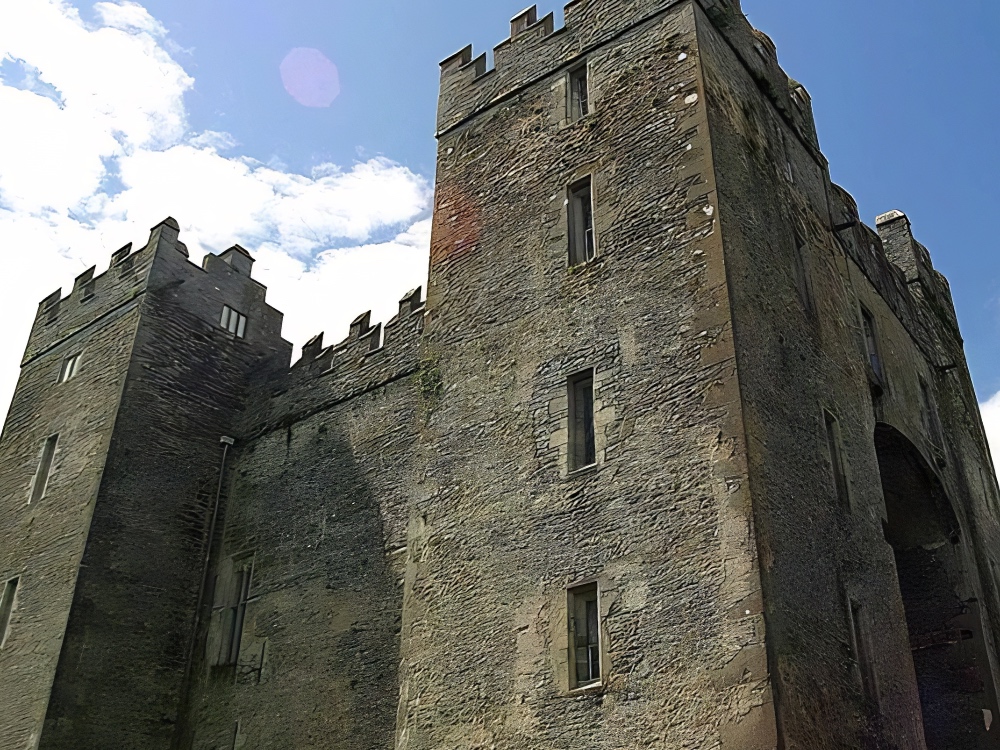
Bunratty Castle in County Clare stands as a well-preserved medieval fortress with a history dating back to the 15th century. It is one of the country”s most iconic landmarks and one of the many unique experiences to do in Ireland.
Both the castle and the Bunratty Folk Park and village are home to several cats who alternate between sleeping in nooks in the castle and bedding down in cozy spots in the surrounding, more humble cottages.
Reserve your guided tour to Bunratty Castle, Ennis, and the Cliffs of Moher here.
The cat cafés of Ireland
While cat cafés are becoming increasingly popular worldwide, Ireland has yet to fully embrace the trend. Kitty Winkles in Belfast aimed to be Northern Ireland’s first cat café but, unfortunately, fell short of its Kickstarter campaign targets. Another cat café, Purr Café, opened in Dublin’s Smithfield area in October 2017, but regrettably, it closed its doors on August 31, 2018.
For a comprehensive list of cat cafés in the UK, check out Your Ultimate Guide to All the Cat Cafés in the UK.
Dean and Nala
Dean Nicholson, a man hailing from Dunbar in Ireland, set out to travel the world on his bicycle. Along the way, he rescued a starving kitten whom he named Nala. Their adventures together have captured the internet’s attention, leading to the creation of a book detailing their travels, titled Nala’s World, as well as a children’s book.
Medieval laws pertaining to cats
The Catslechtae is a legal framework that acknowledged the economic worth of a cat.
It established that a talented mouser held the same value as three milk cows. However, a cat incapable of purring (satisfactorily) was appraised at only half the monetary value.
Additionally, guidelines were stipulated regarding the compensation to be paid to individuals whose food was pilfered by cats.
Cat curses
In Irish traditions, it is a common practice to invoke the ferocity of felines. A frequently used expression states, “Mallacht mo chait ort” (molioct muh hhot earth), translating to “the curse of my cat on you.” Another curse involves the wish “Go n-ithe an cat thú is go n-ithe an diabhal an cat” (guh nih hah an cot who iss go nih hah on jowl who), meaning “may the cat eat you, and may the devil not eat the cat.”
Date with a cat
In Ireland, it is now legally permitted to bring your cat to a restaurant.
The prohibition on cats and dogs in restaurants, which was established in the 1950s, has now been overturned. While this rule was set in place to allow assistance dogs that help people with visual impairments and children and adolescents with autism, it also means you and your feline companion can now technically enjoy a public meal together.
Cat stamps
In 2007, the Irish Post Office issued its very first postage stamps featuring cats. They were illustrated in a comical style by political cartoonist Martin Turner. Another notable set emerged in 2017, presenting photographs of four pedigree cats—Persian, Burmese, Siamese, and Maine Coon. These stamps also aimed to promote awareness of animal welfare issues.
Gregans Castle Hotel
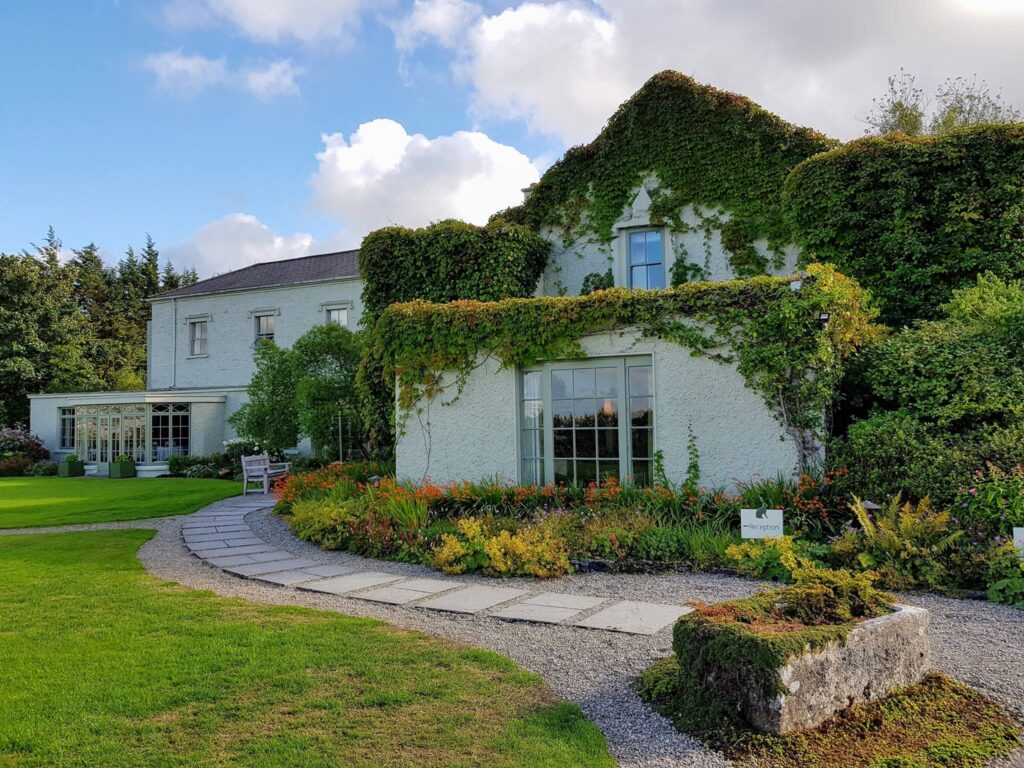
Gregans Castle Hotel, near Ballyvaughan in County Clare, is an exquisite 18th-century manor nestled in beautifully maintained gardens along the Wild Atlantic Way, offering breathtaking views across the Burren hills to Galway Bay. It has been hosting guests since the 1940s.
Inside, you’ll be greeted by inviting open fires, warm candlelight, and a captivating blend of decor—from modern art to antique furniture.
More importantly, they have a resident feline guardian: a charming white cat with black markings, who answers to the name Shelley.
Irish drinking songs for cat lovers
In the absence of official Irish drinking songs dedicated to cats, Marc Gunn has created an album titled “Irish Drinking Songs for Cat Lovers.” The collection includes a song parodying the timeless classic “Whiskey in the Jar,” now playfully titled “Whiskers in the Jar.”
Irish cat names
Two of the earliest cat names – found in medieval Irish law texts – were Méone, a diminutive meaning “little meow,” and Cruibne, meaning “little paws.”
Nowadays, the Irish often call their cats Craic, meaning “great fun;” Aoife, signifying “beautiful” or “radiant;” Ciarán, translating to “dark-haired;” or Finn, which means “fair” or “white.”
Read next: 200+ Irish cat names (with meanings)
More trivia about cats in Ireland
Enjoyed these tidbits about cats in Ireland? If so, consider exploring The Cats of Ireland: An Irish Gift For Cat Lovers With Legends, Tales And Trivia Galore by Seamus Mullarkey. This 118-page book delves into Irish cat trivia. While not as extensive and polished as Mullarkey’s subsequent work, The Cats of Britain, it’s an entertaining resource that delves even deeper into the world of feline facts beyond what’s covered here.
Read next:
20 fun facts about cats in Istanbul, Turkey
Cats in Thailand – 40 fun facts and trivia
Pin these interesting facts about cats in Ireland!