

Last Updated on 19 May 2026 by Vanessa
Author CJ Fentiman, also known as Carla Francis, has visited Cat Café Asakusa Neko-en in Tokyo, Japan, multiple times.
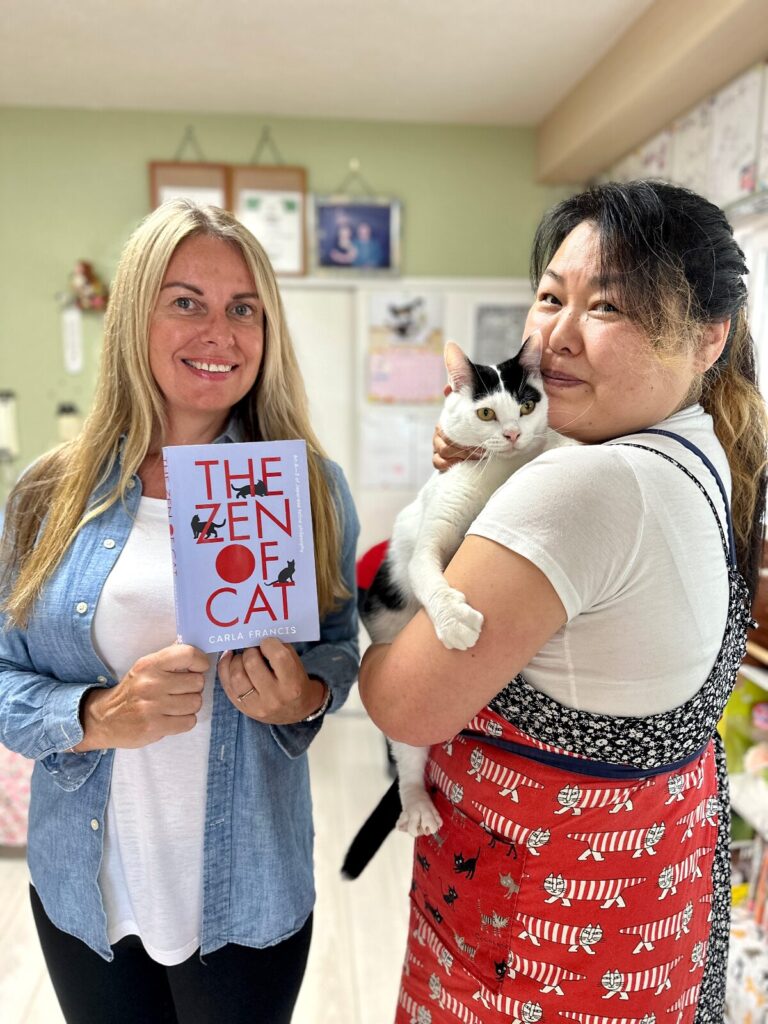
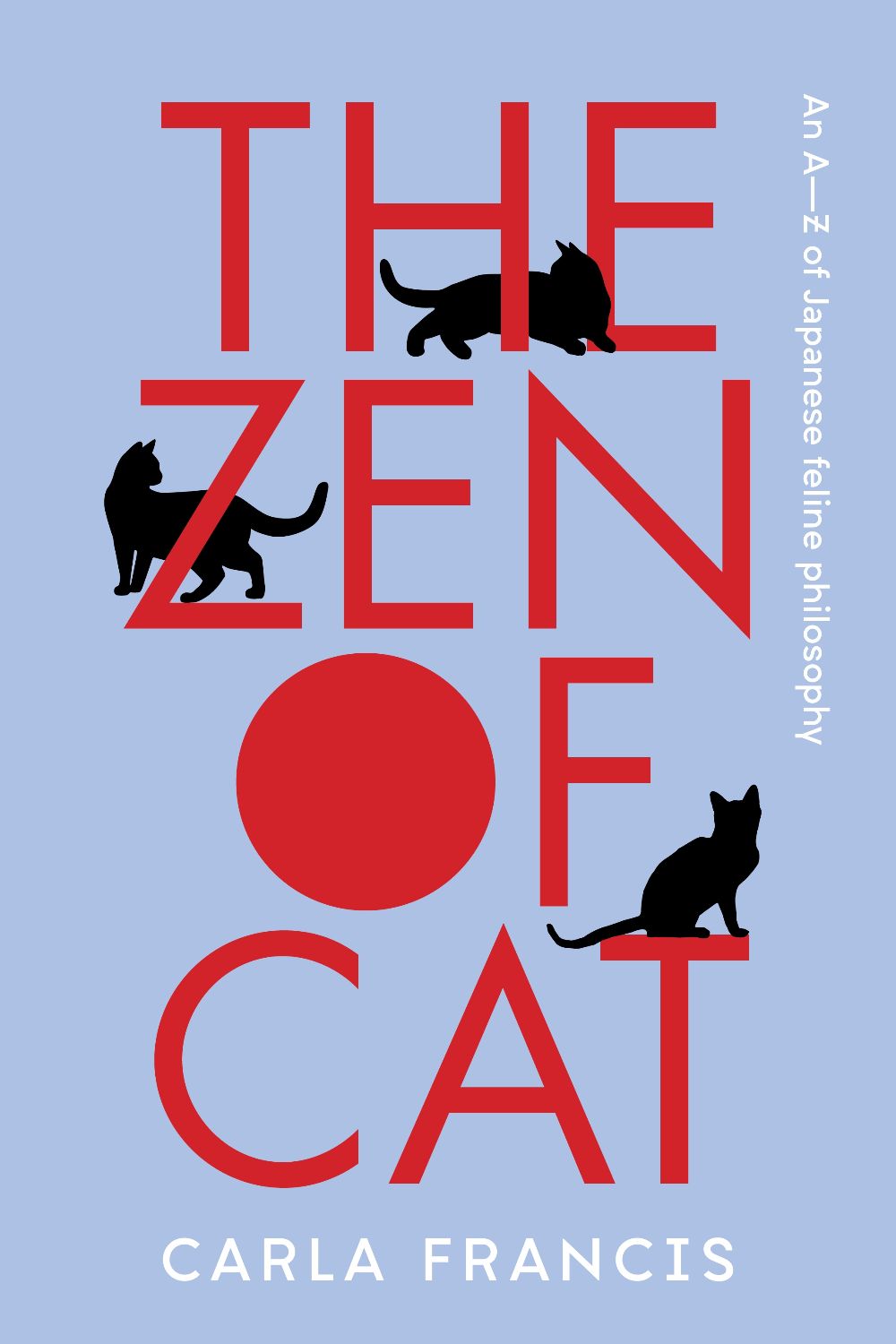
“Whenever I am in Japan, I try to visit this place because of the wonderful work Takako-san does. While some cat cafés are for entertainment purposes only, this one not only rescues and rehomes, but also educates visitors about cat welfare,” the author writes in her latest book, The Zen of Cat.
In the chapter Torimadosu (a Japanese term meaning “to find strength after something unexpected happens”), the author explains that Takako has rehomed over 50 cats from the Fukushima exclusion zone following the tragic events of the 2011 Tōhoku earthquake and tsunami. These cats bounced back faster than humans, thus being the perfect example of Torimadosu.
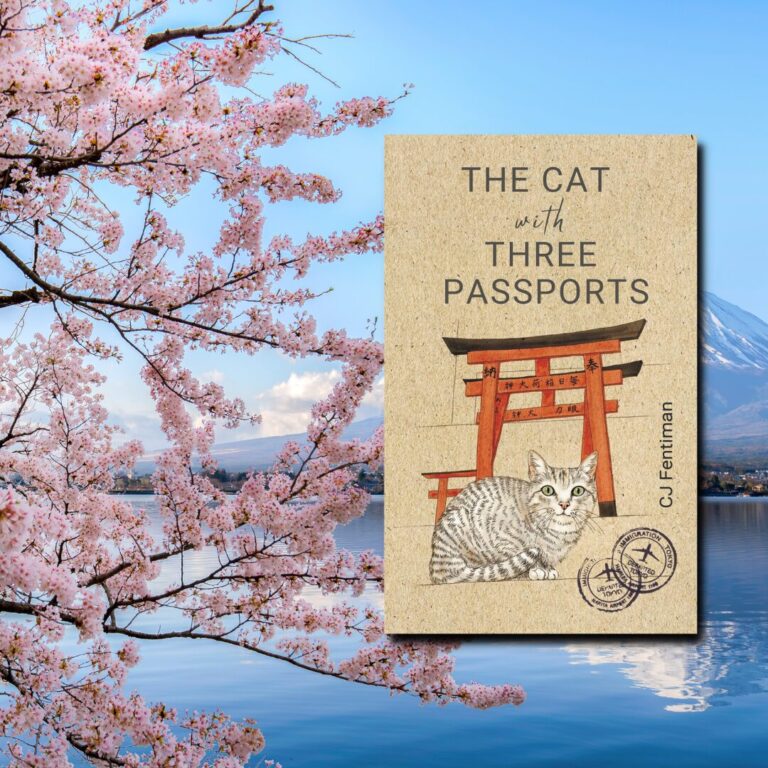
Here’s an excerpt from CJ’s previous book, The Cat With Three Passports, describing her first experience at Cat Café Asakusa Neko-en.
Inside Cat Café Asakusa Neko-en in Tokyo

Excerpt from the book The Cat With Three Passports by CJ Fentiman
“Let’s head to the nearest cat café,” I said brightly.
Ryan rolled his eyes, but he was smiling. He wasn’t as keen as I was to go to one of Japan’s famed cat cafés, but he was perfectly willing to humor me.
We had waterproof rain jackets and so, undaunted by the wet, we made a dash for the main street and started walking in the general direction of where my guidebook said we would find a cat café. Our path led us through the Ginza district where the streets were less busy, because they were lined by high-end shops that only the wealthy could afford. We also walked past interesting nooks that held yakitori (ramen) eateries whose entrances were decorated with colored posters of old shogun movies. My nose was assailed by the aromas of fermented soy sauce wafting out the open doorways. We stopped at a tiny Shinto shrine tucked under a train bridge that seemed to be dedicated to some sort of animal. At first glance, I thought it was either a cat or a dog. When I got closer, I realised it was a fox. A pair of foxes, actually: beautiful stone fox sculptures stood on either side of the little shrine with a red and white rope dangled perfectly in the centre over the doorway. People had left offerings, even Maneki-Nekos, the white beckoning cat, and other good luck charms.
The fox plays an important role in the Shinto faith. It is the messenger of Inari, a major Shinto goddess who is the deity of rice. Inari is literally the goddess of the nation’s sustenance. Honouring the animal at the shrine made me question how a fox could be so revered in Japan, yet vilified in England as a pest worthy of being hunted down by packs of ravenous hounds. Ryan could have stayed at the shrine for an hour snapping photos, but I was determined to visit a cat café. With my improved Japanese skills, I asked a few people for directions but, as usual in Japan, no one seemed to know where the cat café was. So, Ryan and I jumped into a black saloon-style taxi, hoping the driver would know the way to the feline-petting establishment. “Wakaranai,” (I don’t understand) the taxi driver said, shaking his head at the address. He started driving down a side street. I swung my head back and forth like I was watching a tennis match as I looked for kitty signage. I was growing increasingly disheartened by the lack of anything felinerelated when Ryan said suddenly: “That’s it! Over there.”
He’d spotted a large poster of a white mother cat with ginger ears and four white and ginger kittens on a billboard beside a building, which also had a wooden sign, a hand drawn poster of other cats, and an arrow pointing at the door.
The taxi driver had understood the address after all. We paid him gratefully and got out of the taxi.
We dashed through the front door of the cat café to avoid the rain and were brought up short by a matronly-looking Japanese woman dressed in an oversized sweater and green apron. We dutifully paid our cover charge, placed our backpacks in a locker, washed our hands, removed our shoes, and put on the usual brown slippers provided in public establishments. Finally, we were allowed to climb a flight of stairs to the first floor taken up entirely by the café. We walked excitedly into the large main room to meet the kitties.
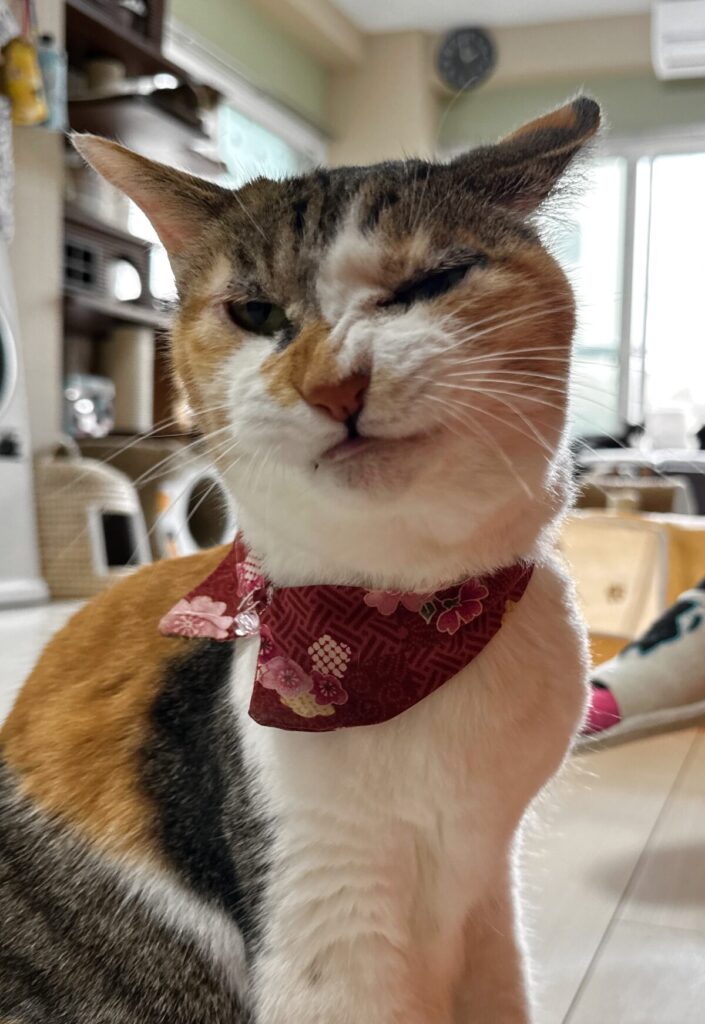
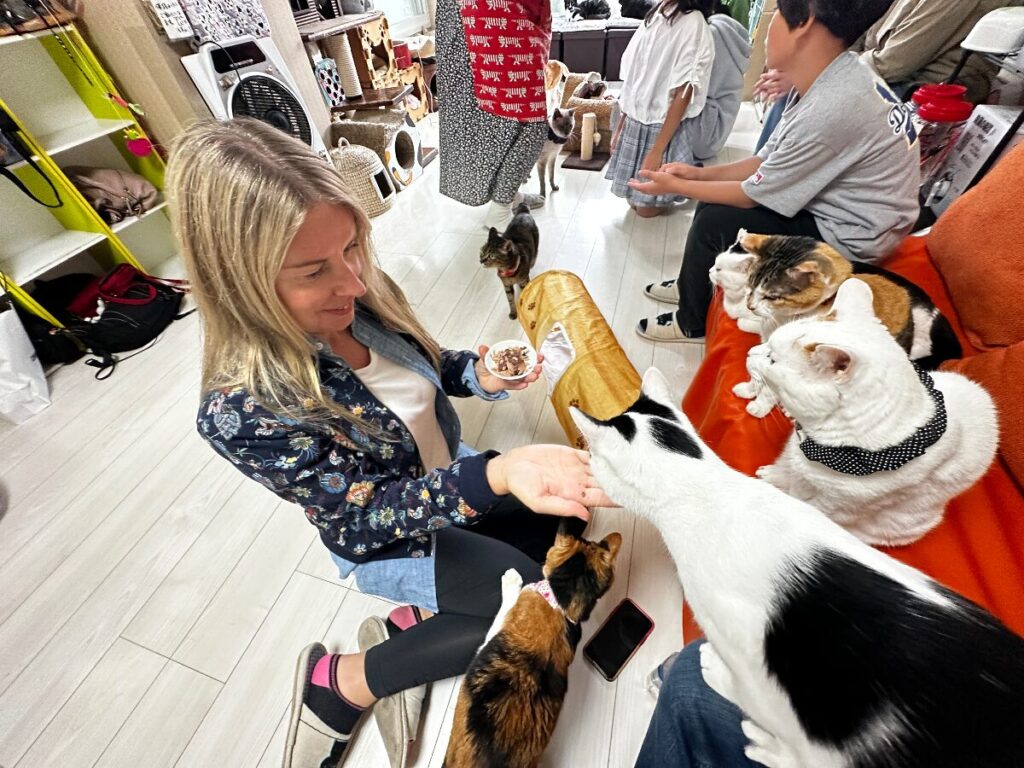
The café had a linoleum floor with lots of mats for cats to scratch, along with lots of cat trees and cubes, and shelves with cat beds. Long windows on the back wall let in lots of sunlight in which many of the cats were napping. Five low lounges with low coffee tables and armchairs around the perimeter were presumably for human visitors, but of course several cats had claimed some of them. A few brightly-coloured cat-themed knick-knacks were displayed on shelves and counters, along with for-sale items like tea in cat-shaped packages, cat-shaped clothes pegs, and designer cat-shaped handbags.
Unlike almost every other Tokyo establishment, the café was not crowded. In fact, it was nearly empty, probably because it did not serve food, only tea. This was a place for people to come and pet and play with cats and then leave.
A rather large ginger Scottish Fold swaggered past us, keeping an eye on the Japanese customers sipping tea, talking, and petting whatever cat was to hand. I spied a pretty ginger and white cat sitting in a regal faux leopard-skin chair, its eyes half closed and mouth slightly open. I was in heaven. We sat down at a low wooden table.
“Look at this,” Ryan said, opening a photo album that rested on the table. It had pictures, descriptions, and profiles of all twenty-three cats living at the café.
Our efficient waitress had appeared at our table before I could read even the first profile. Ryan ordered a coffee to warm himself up, I ordered green tea, and then I settled in to read aloud to Ryan every single one of the twentythree cat profiles.
“This is wonderful,” I said happily.
“This one looks like Garfield,” Ryan said pointing at a rotund ginger tabby with a self-satisfied expression.
Having gone through the entire album, Ryan picked up a cat wand with something feathered at the end and became instantly engrossed in playing with a tabby that resembled Takashi.
After our waitress brought our drinks, I settled back in my chair to people and cat watch. A middle-aged Japanese couple sat happily in one corner with an eager black kitten batting at and scampering after the feathered toy they dangled in front of it. A mother looked on with a smile as her seven-year-old daughter squealed in delight at a young male tabby, an exact Takashi lookalike, batting at the feather at the end of the wand she held. The tabby clearly loved the attention they were lavishing on him. A pair of American tourists in their twenties walked into the café and promptly sat down on the floor, dangling a string for a pure white female cat that delighted in jumping in and out of wicker baskets on the floor in determined pursuit of that string.
What amazed me was not the diversity of the cats, but the diversity of the customers, all of whom had come together because of one thing: their love of cats. I felt a little overwhelmed with happiness at finding other people who loved cats as much as I did, and also the fact that it was another sign of ikigai was at work.
It took some doing, but after almost an hour, Ryan finally pried me out of the cat café. “I want to see the more traditional side of Tokyo,” he insisted, so we made our way via subway to the historic Asakusa entertainment district, which is famous for its enormous Buddhist temple, Sensō-ji, built in the seventh century, destroyed in World War II air raids, and rebuilt after the war.
Practical information regarding Cat Café Asakusa Neko-en
Address
Cat Café Asakusa Neko-en, Ikeda Bld. 3FL, Hanakawado 2-7-6, Taito-ku Tokyo, 111-0033, Japan.
Contact information
Telephone: 03-6231-7944
Email: info@asakusanekoen.com
Opening hours
Cat Café Asakusa neko-en is open every day (except Tuesdays) from 12:00 pm to 08:00 pm.
More things to do in Tokyo
Looking for more things to do in Tokyo? Then check out this Tokyo itinerary.
Conclusion
Are you eager to read more about the author’s experiences with cats in Japan?
Then check out her books The Cat With Three Passports and The Zen of Cat, which are available in both paperback and ebook editions.
If you want to know more, check out this interview with author CJ Fentiman.
Text and photos by CJ Fentiman.
Don’t leave without pinning this article on Cat Café Asakusa Neko-en!


One Response
I want to visit a cat cafe, but there aren’t any here. Need to check out where the nearest one is. Great post.
Thank you for joining the Happy Tuesday Blog Hop.
Have a fabulous day and week. ♥